

Quick alert for future Germany students!!!
If study in Germany is on your vision board for 2026, stop scrolling. This guide is written exactly for you. Germany today is not just known for strong universities, it is known for real opportunities, global exposure, and a future that feels stable and rewarding for international students. But the truth is, the journey to Germany does not start with a visa form. It starts with clarity. Most students feel excited but also confused. Which university is right? Public or private? What does the visa officer really look for? Is the information online actually correct? When answers are unclear, even a good profile can feel stuck. This is exactly why this guide has been created. This blog is designed for students who genuinely want to study in Germany and apply for the Germany Study Visa 2026 with confidence. It does not overload you with complex terms. Instead, it walks with you, step by step, explaining what matters, what to avoid, and how to plan smartly from the beginning. Most importantly, this guide is written under the professional guidance of Ms. Parwinder Kaur, Director of West Highlander Immigration and an ICEF Certified Agent, ensuring that every detail shared is correct, practical, and aligned with real visa expectations.
If Germany feels like your future, let this guide be your first clear step forward.
Contents of This Complete Germany Study Visa 2026 Guide
- Germany as a country
- Understanding the German Education System
- Types of Universities in Germany
- Top Universities in Germany for International Students
- Popular Courses and Career-Focused Programs in Germany
- Intakes, Fees, Scholarships for International Students
- Entry Requirements for Germany: Bachelor’s and Master’s Explained
- Blocked Account and Financial Proof Made Easy
- Part-Time Work and Post Study Options in Germany
- Step-by-Step Process to Apply for Germany Study Visa 2026
- Success Stories with West Highlander and a lot more…..
Why choose Germany as a study destination in 2026?
Before we dig into the Germany education system, universities, and visa process, let’s pause for a moment and talk about the country itself. This step is important because studying in Germany also means living in Germany, and knowing the place helps you feel prepared and confident. Germany is located in central Europe and shares its borders with nine countries, making it one of the most well-connected nations in Europe. With a population of around 83 million people, Germany is one of the most populated and developed countries in the European Union. It is known for its clean cities, strong infrastructure, and well-organised public systems. Life here feels structured, safe, and predictable, which is comforting when you are away from home. The weather in Germany changes with the seasons. Summers are generally mild and pleasant, while winters can be cold, especially between December and February. Spring and autumn are calm and beautiful, with greenery, open spaces, and a relaxed pace of life. Germany is famous for its rich history, castles, music, festivals, football culture, and engineering excellence. From modern cities like Berlin and Munich to peaceful towns and scenic countryside, the country offers a balanced lifestyle.
German people are known for being disciplined, punctual, and honest, but they are also respectful and welcoming toward international communities. You will meet people from many cultures, making daily life feel global and inclusive. Germany values safety, equality, and quality of life, which is why so many international students choose not just to study here, but to build their future here.
How does the German education system work for international students?
Now that you have a clear picture of Germany as a country, let’s gently step into how the education system in Germany works, because this is the heart of your study in Germany journey. The German education system is known worldwide for its strong structure, practical learning, and high academic standards. It focuses not just on theory, but also on real skills that connect directly with industry and careers. Germany offers different types of universities, each serving a clear purpose. There are public universities, private universities, universities of applied sciences, and foundation or pathway providers. Each type is designed to support different academic goals, whether you are interested in research, hands-on learning, or career-focused programs. The beauty of study in Germany is that students can choose an institution that truly matches their background and future plans. The education system follows a clear credit-based structure, making it transparent and well organised. Courses are taught in English as well as German, especially at the bachelor’s and master’s level. Assessment methods are fair and structured, and students are encouraged to think independently, ask questions, and build problem-solving skills. Overall, Germany’s education system is student-friendly, globally recognised, and designed to prepare you not just for a degree, but for a strong future ahead.
What types of universities are there in Germany?
PUBLIC UNIVERSITIES IN GERMANY
When most students think about study in Germany, public universities are usually the first thing that comes to mind, and for good reason. Germany has more than 300 public universities, funded mainly by the government. Because of this support, most public universities do not charge tuition fees, even for international students. Students usually pay only a small semester contribution, which covers administration costs and often includes a public transport pass. This makes Germany one of the most affordable study destinations in the world. Public universities in Germany are known for their strong academic reputation and research focus. These universities offer a wide range of bachelor’s and master’s programs in fields like engineering, IT, data science, management, natural sciences, health sciences, and more. Teaching here is structured, detailed, and academically demanding. Professors expect students to be independent, disciplined, and serious about their studies. There is less spoon-feeding, but more freedom to learn deeply. Another important point is that admission to public universities is competitive. Entry requirements are strict, and students must meet academic, language, and sometimes subject-specific criteria. Many programs are taught in German, but there is also a growing number of English-taught master’s programs, especially in technical and management fields.
Public universities are ideal for students who are academically strong, patient with processes, and looking for long-term value rather than quick shortcuts. A degree from a German public university is globally recognised and highly respected by employers. For students planning serious careers and long-term settlement options, public universities are a powerful choice.
PRIVATE UNIVERSITIES IN GERMANY
Private universities in Germany offer a very different but equally valuable study in Germany experience. Unlike public universities, private institutions charge tuition fees, but in return, they provide more flexibility, personalised support, and career-focused education. These universities are gaining popularity among international students who want smoother admissions and practical learning. Private universities usually have smaller class sizes, which means students get more interaction with professors, mentors, and career advisors. Teaching is often more practical, industry-oriented, and aligned with current job market needs. Courses are commonly offered in English, especially at the bachelor’s and master’s level, which makes private universities attractive for students who do not yet speak German fluently. Another key advantage is the faster and simpler admission process. Entry requirements are clear, timelines are shorter, and students receive guidance throughout the application journey. Many private universities also offer foundation programs and pathway options for students who need academic or language support before starting their main degree. Private universities in Germany are especially popular for programs like business management, data analytics, IT, AI, finance, international relations, and health management. These institutions focus strongly on internships, industry projects, and employability skills, helping students prepare for real careers, not just exams.
For students who value structure, guidance, and career readiness, private universities offer a supportive and modern study environment. While the cost is higher, many students feel the return on investment is worth it because of strong industry exposure and job-focused learning.
What’s the difference between public and private universities in Germany?
| KEY AREAS | PUBLIC UNIVERSITIES | PRIVATE UNIVERSITIES |
| Tuition Fees | Most public universities charge no tuition fees, but students still pay a semester contribution for administration and transport. | Private universities charge tuition fees, but this fee often includes academic support, career services, and personalised guidance. |
| Admission Process | Admissions are highly competitive and mostly handled through central portals like Uni-Assist, which can take time. | Admission processes are faster, more direct, and clearly guided by the university admission team. |
| Entry Requirements | Very strict academic and language requirements; even strong profiles can face rejection due to limited seats. | More flexible entry requirements with profile-based evaluation rather than only grades. |
| Language of Instruction | Many programs are taught in German, especially at bachelor’s level; English options are limited. | Most programs are fully taught in English, making them easier for international students. |
| Class Size | Large lecture halls with high student numbers and limited personal interaction. | Small class sizes allowing close interaction with professors and personalised attention. |
| Teaching Style | Strong focus on theory and research, with limited practical exposure in some programs. | Highly practical, industry-oriented teaching linked with real-world applications. |
| Student Support | Students are expected to manage most things independently, including paperwork and planning. | Dedicated student support teams help with academics, accommodation, and settling in Germany. |
| Industry Exposure | Internships depend largely on student efforts and external applications. | Internships, projects, and industry collaborations are often built into the curriculum. |
| Career Preparation | Career guidance is available but limited due to large student numbers. | Strong career services, CV workshops, interview preparation, and employer networking. |
| Flexibility in Intake | Mostly fixed intakes with limited flexibility if deadlines are missed. | More flexible intakes and multiple start dates for international students. |
What are the top universities in Germany for international students?
Let’s be honest. When students start planning to study in Germany, the biggest confusion is not the visa, it is the university choice. Open any website and you will see hundreds of names, rankings, and opinions, all saying different things. This is where most students feel stuck. Which university will accept my profile? Which one teaches in English? Which one really helps with careers after studies? These are real questions, and they deserve real answers. That is why we did not simply list random universities here. We have carefully shortlisted universities based on the questions, concerns, and goals of international students who are planning to apply for the Germany Study Visa 2026. If you want your study in Germany journey to feel planned, guided, and stress-free, the universities below are worth knowing about.
GISMA University of Applied Sciences
One of the names that comes up again and again when international students plan to study in Germany is GISMA University of Applied Sciences, and there is a good reason behind it. GISMA was founded in 1999 and has built a strong reputation for offering modern, career-focused education that is easy to adapt to for students coming from different countries. The university has campuses in Potsdam, Berlin, and Hamburg, all of which are well-connected cities with good student life and strong industry presence. What makes GISMA especially popular among international students is its English-taught education. All major programs are offered in English, which makes it a comfortable choice for students who want to study in Germany without first mastering the German language. GISMA focuses strongly on practical learning and industry relevance. Popular programs include Business Management, International Business, Data Science, Artificial Intelligence, Digital Transformation, Software Engineering, and related technology and management fields.
GISMA is best suited for students who want a clear, structured learning environment, smaller class sizes, and regular interaction with faculty. The university places strong emphasis on real-world skills, projects, and career preparation, which helps students feel more confident about their future plans. For international students looking for a smooth transition into the German education system, GISMA often feels like a supportive and well-planned starting point.
University of Europe for Applied Sciences
This is a well-recognised private university with a modern and practical approach to learning, and it has become a popular choice for students from around the world. UE has campuses in major cities like Berlin, Hamburg, Potsdam, and Iserlohn, giving students the chance to live in lively and culturally rich places in Germany. UE was officially formed in 2017, bringing together experienced education providers under one name to create an international learning community. The university offers a wide range of English-taught bachelor’s and master’s programmes in fields such as business, sport, tech and software, art and design, health and psychology, and related areas that connect theory with real-world skills. What makes UE stand out is its practice-oriented approach and strong focus on preparing students for real careers. The university promotes creativity, digital thinking, and personal development through hands-on learning, group projects, and collaboration with companies. It also has a very diverse student community, with learners from more than 140 countries, which helps international students feel comfortable, connected, and supported right from the start.
UE is especially suited for students who want English-taught courses, practical learning, and a lively global learning environment. Whether you are interested in business innovation, creative arts, or technology, UE offers a supportive setting where you can grow academically while preparing for future career opportunities.
Munich Business School
When it comes to study in Germany, Munich Business School (MBS) also stands out as one of the most respected private business universities, especially for students who want a strong international focus and practical career learning. MBS is located in the vibrant city of Munich, in the state of Bavaria, a city known for its lively culture, global business environment, and high quality of life. The university was originally established in 1991 and became the first state-recognised private university in Bavaria in 1999, which shows its long experience in higher education here. What makes Munich Business School special is its clear focus on business education with a global outlook. The university offers a range of programs in business, including Bachelor’s, Master’s, MBA, and even a DBA (Doctor of Business Administration). All of these programs are designed not only to give strong academic knowledge but also to build real skills that employers value. Many courses are offered fully in English, which is great for international students who want to learn without worrying about German language barriers at the start.
MBS is known for its mix of theory and practical learning, small class sizes, and close support from professors and the campus team. Students here often work on real industry projects, group tasks, and business networking opportunities that help them grow professionally. If you are someone who wants to focus on international business, entrepreneurship, marketing, or leadership, Munich Business School can be a truly supportive and exciting place for your journey.
New European College
If you are looking for a small, focused, and very personal study experience in Germany, New European College (NEC) is a name worth knowing. NEC is located in Munich, one of Germany’s most important business and innovation cities, known for strong companies, startups, and international career opportunities. The college was founded in 2014 with a clear goal: to offer high-quality, English-taught business education in a close and supportive learning environment. New European College offers Bachelor’s, Master’s, and MBA programmes mainly in areas like Business Administration, International Management, Entrepreneurship, Marketing, and Finance. All programmes are taught completely in English, which makes it very comfortable for international students coming from different academic and cultural backgrounds. One of the strongest points of NEC is its small class size, where students get direct access to lecturers, personal academic guidance, and regular mentoring.
NEC is best suited for students who prefer individual attention, clear structure, and practical business learning rather than large lecture halls. If you want to study business in Munich, stay close to industry, and learn in a calm but professional setting, New European College can be a strong and practical choice for your Germany study journey.
CBS University of Applied Sciences
CBS University of Applied Sciences is a state-recognised private university in Germany that is well known for its strong business focus and applied learning style. The university was founded in 1993 and is headquartered in Cologne, one of Germany’s major media, business, and student cities. Over the years, CBS has expanded and now also has campuses in Mainz and Potsdam, giving students options beyond one single location. CBS offers Bachelor’s and Master’s programmes mainly in areas such as Business Administration, International Business, Digital Technologies, Finance, Marketing, Project Management, and Social Sciences. Many programmes are available fully in English, which makes CBS a comfortable choice for international students who want to study in Germany without a German language barrier at the start. The university follows a very practical, application-oriented approach, where theory is closely linked with real business cases, projects, and teamwork.
CBS is best suited for students who want career-focused education, clear structure, and industry-relevant skills. If you are looking for a modern university that prepares you for the job market while keeping learning simple, practical, and personal, CBS University of Applied Sciences can be a smart choice for your study in Germany plan.
EBS University for Business and Law
EBS University of Business and Law is one of Germany’s oldest and most respected private universities, especially known for its strength in business and law education. It was founded in 1971 and is state-recognised, with its main campuses located in Oestrich-Winkel and Wiesbaden, close to Frankfurt, which is Germany’s main financial hub. This location gives students strong exposure to corporate offices, law firms, and international companies. EBS offers Bachelor’s, Master’s, MBA, and law programmes, mainly through its EBS Business School and EBS Law School. Many programmes are taught fully in English, particularly at the master’s level, making it a strong choice for international students. The university is known for its academic depth, leadership focus, and close connection with industry. Classes are small, discussions are active, and students are encouraged to think critically and independently. EBS is ideal for students who want a serious academic environment, strong professional network, and long-term career growth, especially in business management, finance, entrepreneurship, and corporate law.
Fresenius University of Applied Sciences
If you are thinking about study in Germany and want a university that feels practical, supportive, and easy to adapt to as an international student, Fresenius University of Applied Sciences is definitely worth knowing about. Fresenius is a state-recognised private university with a long tradition in applied education. It traces its roots back to a science and lab training institute from the 1800s and became a modern university of applied sciences in 1971. Today, it has multiple campuses across Germany in cities like Idstein, Berlin, Cologne, Munich, Frankfurt, and Hamburg, giving students the choice to study in lively and culturally rich environments. What makes Fresenius special is its wide range of practical and industry-focused programmes that are designed to help students build real-world skills. Fresenius offers bachelor’s and master’s courses across areas such as international business management, computer science, industrial engineering, biomedical sciences, fashion and design, sustainability and creative industries, and more, many of which are available fully in English in cities like Berlin and Cologne. The university also supports students with housing information, career services, language support, and intercultural integration, making life easier for those coming from abroad.
Fresenius works closely with companies and local industries, so you get chances to learn through projects, collaborate with peers, and prepare for jobs after graduation. If you want a blend of practical learning, global outlook, and support during your study journey in Germany, Fresenius can be a strong and welcoming choice.
SRH University
SRH University is one of the largest and most flexible private university groups in Germany, with a strong reputation for hands-on learning, personal support, and career-focused education. It is part of the SRH Holding, a non-profit foundation that has been active in education and healthcare since 1966. SRH University brings together many campuses across Germany, including in Berlin, Heidelberg, Hamburg, Stuttgart, and other cities, offering students a wide choice of places to study and lifestyles. What makes SRH special is its CORE teaching principle (Competence Oriented Research and Education), which focuses on learning by doing, small groups, real projects, and personal mentoring rather than only lectures. This approach helps students develop not just knowledge, but practical skills and confidence they can use in real work settings soon after graduation. SRH offers over 200 study programmes in English and German across fields like business, technology, engineering, psychology, health, design, IT, and more, so students with different interests can find the right path. The university attracts students from more than 140 countries, creating a truly global and diverse campus atmosphere that helps international students feel at home from the start. Many students also appreciate that SRH works closely with companies, helping them get internships, industry projects, and a practical edge for their careers. Whether you want to explore digital business, creative arts, engineering, or health sciences, SRH University gives you tools, support, and real-world experience to shape a meaningful future.
Macromedia University
Macromedia University of Applied Sciences is one of Germany’s well-known private universities, especially for students who want to blend creative thinking with practical business and media skills. It was founded in 2006 and is part of the Macromedia GmbH education group. The university has several urban campuses across Germany, including Munich, Berlin, Stuttgart, Hamburg, Cologne, Leipzig, Frankfurt, and Freiburg, giving students a lively city experience in places full of culture, creativity, and industry opportunities. What makes Macromedia stand out is its wide and modern range of study programs that connect media, design, technology, and management. Students can study Bachelor’s and Master’s degrees in areas like media and communication design, film and television, business and management, fashion, games and animation, psychology, digital technologies, and marketing. Many of these programs are also available fully in English, making it easier for international students to begin their education without needing advanced German right away.
One of the best parts about studying at Macromedia is the practical approach to learning. The university has strong ties with companies and real creative industries, which means students often work on practical projects, industry challenges, and real-world assignments that help build confidence and job-ready skills. Macromedia also welcomes students from many countries, creating a diverse and lively campus community. Whether you’re interested in media, design, business, or digital creativity, Macromedia University offers a modern, hands-on study experience that feels connected to today’s world of work.
PFH University of Applied Sciences
PFH University of Applied Sciences is a well-established private university in Germany that many international students find interesting because of its practical focus, international opportunities, and industry links. It was recognised in 1995 by the Lower Saxony Ministry of Science and Culture, making it Lower Saxony’s oldest private, state-recognised university. PFH was created with the aim of meeting real business and industry needs, and this mission still guides its programs today. PFH operates mainly from two campus locations- Gottingen and Stade, both in the state of Lower Saxony. Gottingen is often seen as a classic student city with a rich academic feel, while Stade is known for its connection to technology and engineering industries like Airbus and Fraunhofer research. The university offers around 60 study programs across areas such as management, engineering sciences, psychology and business psychology, business law, technology, and healthcare technology. Many master’s programs are taught in English, which is a key reason international students choose PFH. What makes PFH unique is its entrepreneurial spirit and close industry links. The university emphasises practical, real-world learning and encourages students to develop problem-solving and leadership skills that employers value. PFH also works with more than 500 partner companies, giving students opportunities for internships, projects, and career connections that boost their professional growth.
Overall, PFH suits students who want a practical, industry-linked education with international exposure, especially in areas where real skills and hands-on experience matter most.
Berlin School of Business and Innovation (BSBI)
Berlin School of Business and Innovation (BSBI) is a private higher education institution based in the heart of Berlin, Germany, with campuses in other European cities like Hamburg, Paris, and Barcelona. BSBI began its journey in 2017 and started teaching students soon after, aiming to prepare learners for careers in the business world and global industries. At BSBI, the focus is on practical, career-oriented business education that combines classroom learning with real business insights. The school offers a variety of programmes including undergraduate degrees, postgraduate master’s degrees, and doctorate options in areas such as international business, finance, marketing, digital business, project management, and entrepreneurial leadership. Many courses are delivered in English, helping students from different countries study without needing German language skills at the start. Students at BSBI benefit from a diverse international community, where peers come from many parts of the world, creating an engaging learning atmosphere. The school also emphasises industry connections, practical case studies, guest speakers, and workshops, designed to link academic study with career needs.
BSBI is best suited for students who want an English-taught business education with a global feel and who enjoy learning in a lively city environment like Berlin. The focus on leadership, innovation, and real-world business skills helps students build confidence and prepare for careers in international organisations or business settings
What are the top courses to study in Germany?
Now that we are familiar with some of the best universities in Germany, the next big question naturally follows: what should you study? Choosing the right field is just as important as choosing the right university, especially when your goal is long-term career growth in Europe or globally. So let us explore the most popular and trusted fields that students usually opt for when planning their study journey in Germany.
Engineering
Engineering has always been Germany’s strongest academic and industrial pillar, and that is why it remains one of the top choices for international students. Germany is home to global leaders in automotive, manufacturing, renewable energy, and industrial technology, which directly reflects in its engineering education. Students can pursue bachelors in Germany or masters in Germany in fields like Mechanical Engineering, Automotive Engineering, Electrical Engineering, Civil Engineering, Industrial Engineering, and Mechatronics. Universities such as SRH University, PFH University of Applied Sciences, Fresenius University of Applied Sciences, and CBS University of Applied Sciences offer engineering programs with a strong applied focus. These programs are designed to balance theory with hands-on projects, lab work, and industry exposure. What makes engineering in Germany attractive is the clear career outcome. Graduates often move into roles such as design engineers, project engineers, quality engineers, process engineers, and technical managers. Many universities work closely with companies, which means students gain real project experience even before graduating. For master’s students, Germany also offers strong research exposure combined with industry relevance. If you enjoy problem-solving, structured thinking, and practical learning, engineering in Germany offers stability, respect, and long-term career potential across Europe and beyond.
Computer Science and IT
Computer Science and IT are among the fastest-growing fields in Germany, driven by digital transformation, artificial intelligence, and data-based decision-making. International students commonly choose bachelors in Germany or masters in Germany in Computer Science, Data Science, Artificial Intelligence, Software Engineering, Cyber Security, and Digital Transformation. Universities like GISMA University of Applied Sciences, SRH University, University of Europe for Applied Sciences, Macromedia University, and PFH University offer modern, English-taught IT programs that focus on real-world skills. These programs are not just about coding. Students learn how technology connects with business, innovation, and problem-solving. Coursework often includes live projects, case studies, group work, and industry tools that employers actually use. Career outcomes are strong, with graduates moving into roles such as software developers, data analysts, AI specialists, IT consultants, product managers, and system architects. Germany’s strong startup ecosystem and tech hubs like Berlin and Munich further increase job opportunities. For students who want future-ready careers, flexible global mobility, and high demand skills, computer science and IT in Germany offer a powerful and practical study path.
Business and Economics
Business and Economics are extremely popular among international students who want management, leadership, and global exposure. Germany offers excellent options for bachelors in Germany, masters in Germany, and especially MBA in Germany programs. Universities such as Munich Business School, EBS University of Business and Law, GISMA University of Applied Sciences, New European College, CBS University of Applied Sciences, and University of Europe for Applied Sciences are well known for business education. Programs usually cover areas like International Business, Management, Finance, Marketing, Entrepreneurship, Supply Chain, and Digital Business. What makes business studies in Germany different is the strong link between theory and real business practice. Students work on case studies, simulations, group projects, and company collaborations. Many programs are taught fully in English and attract students from all over the world, creating a truly international classroom. Career outcomes include roles in management, consulting, finance, operations, marketing, and entrepreneurship. An MBA in Germany is especially valued by professionals looking to move into leadership or international roles. If you enjoy decision-making, strategy, teamwork, and global business thinking, this field offers flexibility and strong career growth.
Medicine and Health
Medicine and health-related fields are gaining strong attention due to global demand for healthcare professionals and applied health sciences experts. While clinical medicine usually requires German language proficiency, international students often choose bachelors in Germany or masters in Germany in areas such as Health Sciences, Healthcare Management, Biomedical Sciences, Psychology, and Public Health. Universities like Fresenius University of Applied Sciences and SRH University offer health-focused programs with a strong applied and research-based approach. These programs prepare students for roles beyond hospitals, including healthcare administration, research, health policy, medical technology, and wellness management. Germany’s strong healthcare system and research environment provide valuable learning exposure. Graduates often work in hospitals, research institutes, healthcare companies, NGOs, and public health organisations. For students who want meaningful careers that focus on people, wellbeing, and long-term impact, medicine and health-related studies in Germany offer purpose-driven education with solid professional outcomes.
Humanities and Social Sciences
Humanities and Social Sciences may not always be linked directly to one job title, but they play a powerful role in shaping global thinkers, researchers, educators, and policy professionals. International students choose bachelors in Germany and masters in Germany in fields like Psychology, International Relations, Sociology, Political Science, Media Studies, Communication, and Cultural Studies. Universities such as SRH University, Macromedia University, University of Europe for Applied Sciences, and Fresenius University offer these programs with modern and practical learning methods. These courses focus on critical thinking, communication skills, research ability, and social understanding. Students often work on real social issues, media projects, research studies, and interdisciplinary tasks. Career outcomes include roles in education, media, human resources, policy research, NGOs, social organisations, corporate communication, and further academic research. If you are someone who enjoys understanding people, societies, communication, and global issues, humanities and social sciences in Germany provide a flexible and intellectually rich study path with diverse career possibilities.
Choosing the right field in Germany is about matching your interests with long-term opportunities. With strong universities, practical education, and global recognition, Germany continues to be one of the most reliable destinations for international students planning their academic future.
When are the intakes in Germany for international students?
When planning your study journey in Germany, understanding the intakes is like knowing when the train arrives so you do not miss your seat. Germany mainly follows two official intakes, and once you understand how they work, planning your bachelor’s in Germany, master’s in Germany, or even an MBA in Germany becomes much easier and smoother. The first and most popular intake is the Winter Intake, which usually starts in October. This is the main intake across Germany and almost all public and private universities offer a wide range of programs during this time. Most international students prefer this intake because course options are maximum, scholarships are more available, and student life is at its best. Application timelines for the winter intake usually begin around December to January of the same year and can run until May or July, depending on the university.
The second intake is the Summer Intake, which generally begins in April. This intake has fewer course options compared to winter, but it is still a very good choice for students who miss the October start or need more time for preparation. Many master’s programs in Germany and selected bachelor’s programs in Germany are available in this intake. Applications usually open around October and close between January and February. Some private universities may also offer flexible or rolling admissions, but the main academic structure still revolves around these two intakes. Once you align your documents, language scores, and applications with the right intake, everything starts falling into place. Germany rewards good planning, and the right intake can set the perfect rhythm for your study journey.
What are the tuition fees and cost of living in Germany?
When students think about studying in Germany, two questions almost always come next: How much will tuition cost? And How much will I spend living there? The good news is that Germany is known for being one of the most student-friendly destinations in the world when it comes to both learning and living costs. For a bachelor’s in Germany at private universities, tuition fees generally range from about EUR 8000 to EUR 12,000 per year, depending on the course and university. For a master’s in Germany, the range is similar, usually around EUR 10,000 to EUR 15,000 per year at private institutions. These programs often include career guidance, internships, and personalised support, which many students find worth the cost. Talking about living costs in Germany, which is a big part of planning your study journey. Germany is comfortable without being too expensive, and most students find life here easy to manage with the right budget. As of now, the German government asks international students to show EUR 11,904 in a blocked account to prove they can cover their living expenses for one year. This amount is used to estimate your basic needs like rent, food, transport, health insurance, books, and personal costs. In simple terms EUR 11,904 acts as a safety net so you can live steadily while you are in Germany.
What is a Blocked Account?
A blocked account is a special bank account that international students use when they plan to study in Germany. It is designed to show the German government that you have enough money to cover your living expenses while studying. The account is “blocked” because you cannot withdraw the full amount at once. Instead, you can only take out a fixed amount each month, which helps you manage your budget while living in Germany. For 2026, students are usually required to have EUR 11,904 in their blocked account for one year, which comes to about EUR 992 per month. This money is meant for rent, food, transport, health insurance, books, and personal expenses. Opening a blocked account is a mandatory step for getting a German student visa. Banks in Germany and some international providers offer this service, and the process is simple. It ensures that students can live comfortably while focusing on their studies without financial stress. This is an important part of your Germany study plan.
What scholarships are available in Germany for international students?
Even though private universities in Germany charge tuition fees, the good news is that they offer many scholarships to make your studies easier and more affordable. Whether you are planning a bachelor’s in Germany, master’s in Germany, or MBA in Germany, there are excellent opportunities to get financial support while studying in top private institutions. These scholarships not only reduce tuition costs but also recognize talent, motivation, and potential, making them a great way to start your Germany journey with confidence. Some of the main scholarship options you should know about in 2026: GISMA University of Applied Sciences offers partial scholarships of about 20 % on tuition fees for bachelor’s, master’s, and MBA programmes, making your overall cost lower and more manageable. University of Europe for Applied Sciences (UE) has UE Scholarships like the Digital Pioneers Scholarship worth about EUR 2,000 total (EUR 1,000 per semester), plus other awards for merit, creativity, and women in technology. CBS University of Applied Sciences offers scholarships up to 25 % off tuition fees for students with strong academic records or social involvement, helping reduce overall costs for bachelor’s, master’s and MBA students. SRH University provides 50 % tuition fee scholarships to selected students as part of its support programmes. PFH University of Applied Sciences awards 25 % fee reductions for top academic performers. Berlin School of Business and Innovation (BSBI) offers merit‑based awards recognising leadership and academic promise, helping reduce student costs. Apply early, write a strong motivation letter, and show your achievements to improve your chances!
What are the entry requirements for international students in Germany?
- Academic Qualifications: For a bachelor’s in Germany, you normally need a completed 12th grade or equivalent from a recognised board. For a master’s in Germany, you must hold a relevant bachelor’s degree from a recognised university. Private universities usually value your overall profile and grades, and many consider work experience or motivation too. Unlike public universities, private ones often look at your full application rather than only strict grade cut‑offs.
- Language Requirements: If your programme is taught in English, you typically need an English test score like: IELTS: around 6.0–6.5 (bachelor’s) and 6.5+ (master’s), TOEFL: around 80–90. Some private universities accept other English certificates too. If the course is in German, you’d need German tests such as TestDaF or DSH at required levels.
- APS Certificate (Country Check): If you are from India, China, or Vietnam, you usually need an APS certificate (“Academic Evaluation Centre”) before applying or at least before your visa stage. This certificate verifies your academic documents are real and recognised. It’s a common requirement for many German admissions and visa processes.
- Proof of Funds & Blocked Account: Most private universities require proof you can support yourself financially. For your visa, you must show a blocked account with at least EUR 11,904 for one year, even if your tuition is paid with scholarships.
- Supporting Documents Checklist: When you apply, you generally need: Academic transcripts and certificates, Passport copy, English/German language scores, Updated CV, Letters of Recommendation (LORs) if requested- especially for master’s or MBA applications.
- Interviews or Extra Assessments: Some private universities may ask for a short online interview, portfolio (for design/media), or specific assessments. This varies by university and programme. It’s always good to prepare a strong motivation letter and be ready for a video call if asked.
What is an APS Certificate and why is it important?
An APS Certificate is a document issued by the Academic Evaluation Centre in Germany. The APS certificate checks and verifies that your previous academic documents, like school or university certificates, are genuine and valid. It is very important because German universities and the embassy use it to make sure your qualifications are real before giving admission or approving a student visa. Without this certificate, you may not be able to apply to many universities or get a visa. It is a key step to show that your education is authentic, recognised, and trusted by German authorities.
Can I work while studying in Germany?
When you study in Germany as an international student in 2026, you’re allowed to work part time while you complete your degree, and this can be a real bonus for both experience and daily life. Germany lets most international students work up to 120 full days or 240 half days per year, which generally means about 20 hours per week during term time. You can work more hours during semester breaks or holidays, as long as you stay within the yearly limit. Part‑time work helps you earn money for things like food, transport, books, and social activities. It also gives you a taste of German work culture, builds your confidence, and strengthens your CV. These experiences improve language skills and help you learn how the workplace runs in Germany. Most private universities support students in finding part‑time work or internships that fit around classes. You usually don’t need special work permission as long as you stay within the 20‑hour weekly rule during studies; your student residence permit covers this. Balancing study and work can be a great way to grow academically, socially, and professionally while living in Germany.
What is the Job Search Visa (Post Study Work Visa) option?
Completing your studies in Germany is not the end of your journey. In many ways, it is just the moment where everything begins to feel real. This is where the Job Search residence permit becomes important. After finishing your bachelor’s, master’s, or PhD from a recognised German university, Germany allows you to stay back and focus fully on finding a job. This permit is given for up to 18 months, starting from the day you successfully complete your course. These months are not rushed or stressful. They give you breathing space to explore opportunities, attend interviews, understand the job market, and settle into professional life in Germany. During this period, you are allowed to work in any job, full-time or part-time, so you can support yourself while searching for a role related to your qualification. To apply, you must have proof of course completion, valid health insurance, sufficient financial resources, and a valid residence permit at the time of application.
The Job Search permit itself cannot be extended beyond 18 months. However, it is designed as a bridge, not a dead end. Once you find a job that matches your studies, you can move to the next appropriate residence option from within Germany without leaving the country. This makes the transition from student life to working life smooth and realistic. For many international students, these 18 months become the most important phase, where education turns into experience and plans slowly turn into a stable future.
How to apply for a Germany Study Visa?
- Secure Admission From a German University: Your Germany study journey always begins with an official admission letter from a recognised German university. This letter confirms your course name, study level (bachelor’s or master’s), duration, intake, and language of instruction. Without this offer letter, you cannot apply for a Germany study visa. Make sure the university is state-recognised and your program matches your academic background.
- Understand Visa Type and Requirements Early: Germany issues a National Student Visa (Type D) for students planning to study for more than 90 days. Once you receive your admission, carefully check the German Embassy website for your country. Requirements can slightly differ by location, so always follow the embassy instructions where you apply.
- Arrange Proof of Funds Through a Blocked Account: Germany requires proof that you can support yourself financially. As per the latest update, students must show EUR 11,904 for one year, usually through a blocked account (Sperrkonto). This money is locked and released monthly after you arrive in Germany. You can open a blocked account through approved providers before your visa appointment and collect the confirmation letter.
- Arrange Health Insurance Coverage: Health insurance is compulsory for the Germany study visa. For visa filing, students usually submit travel health insurance covering the first few weeks. After reaching Germany and enrolling at the university, students must switch to German student health insurance (public or approved private).
- Prepare Academic, Language, and APS Documents: Collect all academic certificates, transcripts, CV, and motivation letter. For Indian students, the APS Certificate is mandatory for both bachelor’s and master’s degrees. Language proof is also required: English-taught courses usually need IELTS or equivalent, German-taught courses need approved German language proof.
- Fill the Visa Application and Book Appointment: Complete the Germany national visa application form, as instructed by your embassy. Book your visa appointment early, as slots fill quickly during peak intakes. Organise documents neatly in the required order to avoid delays.
- Attend the Visa Interview Confidently: On the appointment day, submit your documents, give biometrics, and attend a short interview. Questions usually focus on your study plans, university choice, funding, and future goals. Honest and clear answers matter more than perfect words.
- Wait for Decision and Prepare for Travel: Visa processing can take 4 to 6 weeks. Once approved, you can plan your travel, arrange accommodation, and prepare for enrollment.
Why choosing the Right Consultant matters for Germany Study Visa?
By the time you reach the Germany study visa stage, you have already made many big decisions. You chose your course, shortlisted universities, planned your intake, and prepared documents. At this point, choosing the right education consultant becomes just as important as choosing the right university. A good consultant does not just “apply on your behalf”. They guide you, correct you, and protect you from mistakes that can cost time, money, or even a visa refusal. Germany has very clear but strict rules for study in Germany. From APS certificates and blocked accounts to university recognition and visa interviews, every step must be done correctly. A reliable consultant helps you choose the right university based on your profile, not just availability. They explain real entry requirements, realistic timelines, and honest chances instead of giving false hopes. They also help you prepare strong motivation letters, organise documents properly, and understand what the embassy really looks for.
Most importantly, the right consultant thinks long term. They guide you not only till the visa but also help you understand part-time work rules, post-study options, and how your course fits into your future career in Germany. This kind of guidance gives peace of mind, especially for students and parents who are doing this process for the first time.
Frequently Asked Questions
What types of universities can I choose to study in Germany?
Germany has more than 300 public universities, mostly funded by the government, alongside a range of private universities. Public universities generally offer a stronger cost advantage, while private universities offer smaller class sizes and more personalised support.
Do public universities in Germany charge tuition fees?
Most public universities in Germany do not charge tuition fees, even for international students. Students usually pay only a small semester contribution, which covers administration costs and often includes a public transport pass.
How much do private university tuition fees cost in Germany?
At private universities, a bachelor’s programme typically costs around EUR 8,000-12,000 per year, while a master’s programme is usually around EUR 10,000-15,000 per year, often including career guidance, internships, and personalised support.
What is a Blocked Account and how much do I need in it?
A blocked account is a special bank account used to show the German government you have enough money to cover living expenses. For 2026, students are usually required to have EUR 11,904 for one year, which comes to about EUR 992 per month, released to you in fixed monthly amounts.
What is an APS Certificate and who needs it?
An APS Certificate (Academic Evaluation Centre certificate) verifies that your academic documents are genuine and recognised. It is usually required for applicants from India, China, or Vietnam before applying or at the visa stage.
Who is guiding this Germany Study Visa guide?
This guide is written under the professional guidance of Ms. Parwinder Kaur, Director of West Highlander Immigration and an ICEF Certified Agent, ensuring every detail is correct, practical, and aligned with real visa expectations.
West Highlander-Your trusted partner for a successful Germany Study Visa journey
Choosing to study in Germany takes courage. It means stepping out of comfort, trusting a new system, and believing in a bigger future. At West Highlander Immigration, we respect that bravery and match it with responsibility, clarity, and strong guidance. Your case is not passed around. It is personally reviewed and supervised by Ms. Parwinder Kaur, Director of West Highlander Immigration and an ICEF-certified expert, who looks into every detail with a clear understanding of what German visa authorities truly expect.
NOTE: Being ICEF Trained Agent Counsellor (ITAC) means Ms. Parwinder Kaur has completed the official ICEF Agent Training Course and exam, a globally recognised professional qualification in international education advising. This training equips her with up‑to‑date knowledge of global study pathways, visa expectations, ethical practices, and how immigration authorities assess applications. ITAC is not a title given lightly- it shows that the counsellor has been educated, tested, and certified by ICEF, a trusted body that connects education agents with university partners worldwide. Knowing your adviser has this credential gives you confidence that every step- from university shortlisting to Germany study visa filing, is informed, accurate, and aligned with real requirements.
Behind her stands a dedicated team of trained counsellors who act as your constant support system. They become your bridge, your voice, and your update channel, making sure every question reaches the right place and every answer reaches you on time. You never feel unsure, unheard, or left behind. From university selection to visa filing, each step is taken with confidence and precision. Over the years, we have successfully handled numerous Germany study visa cases, turning ambition into reality for students who dared to dream bigger. Their success stories are not luck. They are the result of bold decisions, honest planning, and a team that stands firmly beside you until you reach Germany and beyond.
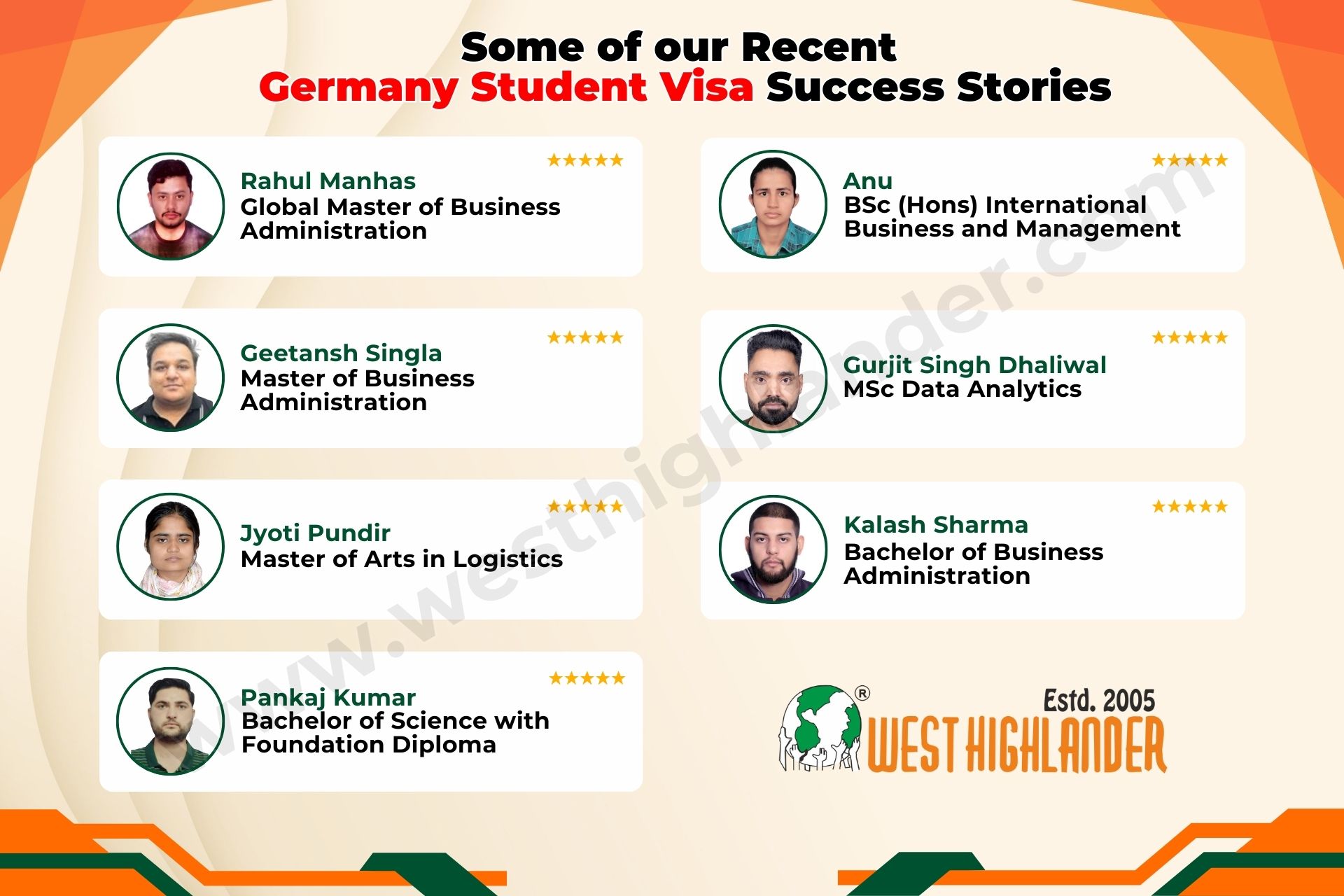
Germany Study Visa Success Stories
Years of Expertise Behind Every Approval
Rahul Manhas (PUNJAB)
Rahul Manhas from Punjab, India, came to us with a quiet but powerful dream. He was working as a Data Entry Operator in a company in Chandigarh, doing his job with sincerity, yet feeling that his growth had reached a pause. Deep inside, he wanted international exposure, better learning, and a career that could take him beyond limits. That desire brought him to us, where we listened to his story, understood his background, and most importantly, respected his ambition. Based on his profile and interest in global business, we guided him toward Berlin School of Business and Innovation, where he chose to pursue a Global MBA. From counselling to visa preparation, every step was planned with care and honesty. Today, Rahul is in Germany, living the life he once imagined. Seeing him move forward with confidence reminds us why we do what we do. Being a small part of his journey truly fills us with pride.
Geetansh Singla (LUDHIANA)
Geetansh Singla comes from Ludhiana, a city known for its strong industrial spirit. Growing up in this environment naturally shaped his thinking and sparked his interest in business from a young age. With a clear entrepreneurial mindset, he chose commerce for his bachelor’s degree and later gained practical exposure by working as a management consultant. Over time, he realised that to move into senior leadership roles, experience alone was not enough. He needed deeper knowledge and global understanding. He knew he wanted to pursue an MBA, but the country and the right university were big question marks. When Geetansh approached us, we carefully evaluated his profile and goals and guided him toward the University of Europe for Applied Sciences in Germany. Today, he is in Germany, learning, growing, and moving closer to the future he always envisioned.
Anu (HARYANA)
Anu is from Haryana and was working as a front desk executive at an education consultancy. Deep inside, she carried a strong wish to study in a foreign country and build a better future for herself. Her confidence, however, was shaken after her Australian student visa was refused. That experience made her fearful of facing another refusal. When Anu came to us, we first understood her concerns and carefully reviewed her previous visa case. We identified the gaps that led to the refusal and worked on them step by step. With the right guidance, we introduced her to the BSc (Hons) in International Business and Management at Berlin School of Business and Innovation. Her Germany study visa was approved, and today, Anu is happily settled in Germany, growing both personally and professionally.
Gurjit Singh Dhaliwal (PUNJAB)
Gurjit Singh Dhaliwal, also from Punjab and had already built strong work experience in India as a software engineer. Even with a stable career, he felt that he needed advanced global skills to grow further in the tech field. With this clear goal in mind, he approached us to explore study options in Germany. After carefully understanding his profile and long-term plans, we guided him toward the MSc in Data Analytics at Berlin School of Business and Innovation. The program matched his technical background and future career goals perfectly. Today, Gurjit is in Germany, learning advanced data skills and moving closer to his dream of building an international career. Being part of his journey has been truly meaningful for us.
Kalash Sharma (PUNJAB)
Kalash Sharma, from Punjab and had just completed his senior secondary education when he started thinking seriously about his future. During this time, he discovered a strong interest in business and how companies work in the real world. He wanted to study something that would give him practical knowledge and a clear direction from the very beginning. When he came to us, we understood his goals and guided him toward the Bachelor of Business Administration (BBA) at EU Business School in Germany. This three-year program offers exactly what Kalash was looking for, a strong foundation in business, management, and real-world skills. Today, he is happily pursuing his undergraduate studies in Germany, confident that he has taken the right first step toward a successful global career.
This is just one drop from a much larger pond of Germany study visa journeys we have proudly guided over the years. Behind every story is a dream, a plan, and the right guidance at the right time. You can be here too. With intakes open and universities welcoming international students, your opportunity is closer than you think. If Germany is calling you, we are ready to walk beside you and help you reach there with confidence, as dreams don’t cross borders on their own, they need courage, clarity, and the right hands to guide them.
