
Scrolling, clicking, comparing, closing tabs… repeat. If your screen is full but your mind is still confused, you are not alone. When it comes to planning to study in New Zealand, the internet can feel less like guidance and more like a maze. Different links, different claims, and somehow none of them tell you the full story. That is exactly where West Highlander steps in. No detours, no confusing jargon, no “one thing on the website and another in reality” surprises. If you are here to understand Manukau Institute of Technology, then that is all we are focusing on, clearly, honestly, and in complete detail. Think of this blog as your boarding gate to Manukau Institute of Technology, New Zealand. Before the journey takes off, we want you to feel confident, informed, and excited. In the sections ahead, we will break down what MIT truly offers, why it is a strong choice for practical and career focused education, and how our official partnership with the institute makes your admission and visa process smoother from day one. As a trusted MIT NZ agent in India, West Highlander does not just share information, we align it with what actually works for students on the ground. And why believe us? Because your flight is guided by a seasoned pilot. Ms. Parwinder Kaur, a Licensed Immigration Adviser for New Zealand, leads this journey with over 20 years of experience in the industry. That means clear advice, accurate guidance, and zero fake promises. So fasten your seatbelt. Your MIT story is about to take off.
About Manukau Institute of Technology
Picture this. You are planning to study abroad, your playlist is on repeat, dreams are big, but your biggest question is simple: Will this place actually help me build a future, or just give me a certificate? This is where Manukau Institute of Technology, better known as MIT, starts to make a lot of sense. MIT is not about loud claims or overhyped promises. It is about skills that work, learning that feels real, and an education that prepares you for life, not just exams. If you are thinking about study in MIT, you are already on a smart path. Manukau Institute of Technology, New Zealand was established in 1970, and since then, it has grown into one of the country’s most trusted and recognised institutes of technology. With more than five decades of experience, MIT has mastered the art of practical education. It is based in Auckland, New Zealand’s largest city, with key campuses in South Auckland, including Otara and Manukau City Centre. The location matters because Auckland is where industries, innovation, and opportunities meet. Studying here means you are close to real workplaces, real employers, and real exposure. MIT strongly believes that learning should never feel disconnected from the real world. Its education model focuses on a strong balance between theory and hands-on practical learning. You learn the “why” in the classroom and the “how” through practical application. Classes are interactive, project-based, and designed to build confidence. The goal is simple: when you step out of MIT, you should feel ready, not nervous.
Industry exposure is one of MIT’s biggest flex. The institute works closely with industry partners to ensure that what students learn stays relevant and up to date. This connection helps students understand workplace expectations early, develop professional skills, and gain experience that employers value. It is one of the reasons MIT graduates are known for being job-ready, adaptable, and confident. MIT is also proudly multicultural and inclusive. The campus vibe is global, welcoming, and supportive, with students from many countries studying together. For those exploring Manukau Institute of Technology for Indian students, this diversity makes settling in easier. You will find familiar cultures, new friendships, and an environment where differences are respected and celebrated. International students are well looked after at MIT. From the moment you arrive, you receive guidance through orientation programs, academic support, wellbeing services, and ongoing assistance. You are never left to figure things out alone. The institute understands that studying abroad is a big move, and it makes sure students feel supported at every stage. In simple words, MIT is for students who want education with purpose. If your plan is to study in New Zealand and you want learning that feels practical, friendly, and future-focused, Manukau Institute of Technology offers a space where your journey feels exciting, supported, and truly worth it.
Top Programs offered at MIT for International Students in 2026
Manukau Institute of Technology is a versatile institute offering a huge range of programmes across different fields from health to tech, business to trades, and everything in between. You can find certificates, diplomas, bachelor degrees, and pathways that connect you with real industry experience and real job opportunities. There’s something for nearly every interest and career goal you can think of. But in this section, we’ll focus on some of the most in demand and popular programmes among international students who choose to study in New Zealand at MIT. These courses have strong industry links, practical learning focus, and a track record of helping students launch careers with confidence and skill.
Bachelor of Nursing (LEVEL 7)
Among all the programmes at Manukau Institute of Technology, one course that consistently stands out for international students is the Bachelor of Nursing (Level 7). This programme is popular for a reason. It is not just about studying nursing from books, it is about becoming a confident, skilled, and work-ready healthcare professional. If you are someone who wants a career with purpose, stability, and global respect, this programme fits right into that vision. The Bachelor of Nursing at MIT is a three-year full-time programme made up of 360 credits, designed to gradually build you into a professional nurse. From the very beginning, the course focuses on both academic learning and hands-on practice. You are not expected to wait until graduation to understand what nursing feels like. Instead, MIT introduces you early to clinical environments so you can connect theory with real patient care step by step.
What makes this programme feel approachable is how learning is structured. You start by building strong foundations in nursing theory, health sciences, communication, and professional practice. As you progress, the learning becomes deeper and more applied, covering areas like adult health, mental health, community care, and clinical decision-making. Alongside classroom learning, students spend a significant amount of time in clinical placements across real healthcare settings such as hospitals and community facilities. This exposure helps you understand how healthcare actually works in New Zealand. MIT’s modern clinical learning facilities play a big role here. Before stepping into real placements, students practise skills in safe, supervised environments that build confidence. By the time you are on the floor, you are not guessing, you are prepared. This is one of the biggest reasons why employers value MIT nursing graduates.
The programme is especially well suited for international students who want a clear pathway into healthcare. For those exploring Manukau Institute of Technology for Indian students, this nursing degree offers structure, strong academic support, and guidance throughout the journey. You are supported not only academically but also personally, helping you adjust to life and study in New Zealand. On successful completion, graduates are eligible to apply to sit the Nursing Council of New Zealand State Examination, which is a key step towards becoming a registered nurse in New Zealand. This makes the programme ideal for students who want a long-term, meaningful career in healthcare. In simple terms, the Bachelor of Nursing at MIT is for students who want to care, contribute, and build a future that truly matters. If your plan is to study in MIT and step into a profession where skills, compassion, and confidence come together, this programme is a powerful place to start.
Bachelor of Engineering Technology (Electrical) & (Civil) (LEVEL 7)
Apart from nursing, Manukau Institute of Technology is also widely known for its strong and practical engineering programmes, especially among international students who want skills that lead to real careers. If you are someone who enjoys problem-solving, building things from scratch, or understanding how systems, structures, and cities actually work, MIT’s engineering pathways deserve a serious look. These programmes are designed for students who want to study in New Zealand and step into industries that are always in demand. Both the Bachelor of Engineering Technology (Electrical) and Bachelor of Engineering Technology (Civil) are Level 7 qualifications, each with a duration of three years full-time and a total of 360 credits. What makes these programmes stand out is their applied learning approach. MIT focuses on teaching engineering in a way that connects theory directly with hands-on practice, so students graduate feeling confident, capable, and industry ready.
The Bachelor of Engineering Technology (Electrical) is all about understanding how electrical systems power the modern world. The programme covers areas such as electrical principles, power systems, electronics, control systems, automation, and safety practices. Students learn how electrical technologies are designed, installed, tested, and maintained across different industries. Learning is supported by labs, projects, and practical work that reflect real engineering environments. This programme is ideal for students who enjoy working with technology, systems, and problem-solving, and who see themselves working in electrical services, maintenance, design support, or technical roles across construction, manufacturing, and infrastructure sectors. On the other hand, the Bachelor of Engineering Technology (Civil) focuses on the built environment and how infrastructure shapes everyday life. This programme introduces students to core civil engineering concepts such as construction technology, materials, structural basics, surveying, geotechnical principles, and project planning. Practical learning plays a major role, helping students understand how roads, buildings, drainage systems, and public infrastructure are planned and delivered. It is a great fit for students who are interested in construction, site work, design support, and infrastructure development, and who enjoy seeing ideas turn into physical structures.
Both programmes emphasise teamwork, communication skills, and real-world problem solving, which are essential in engineering workplaces. Students also benefit from MIT’s strong industry-focused learning environment, where teaching is aligned with what employers actually expect. For international learners planning to study in MIT, these engineering programmes offer a balanced mix of technical knowledge and practical exposure. They are especially appealing to students who want applied engineering qualifications rather than purely theoretical study. In simple terms, if your goal is to study in New Zealand and build a future in engineering that feels practical, relevant, and career-focused, MIT’s Bachelor of Engineering Technology programmes in Electrical and Civil engineering provide a solid, confidence-building pathway forward.
Bachelor of Digital Technologies with majors in networking or software and web development (LEVEL 7)
If engineering is about building the physical world, then digital technologies are about building the world we live in every single day. Apart from nursing and engineering, Manukau Institute of Technology is also well recognised for its future-focused digital technology programmes, which are especially popular with international students who want skills that stay relevant in a fast-moving tech world. For students planning to study in New Zealand, this programme is a smart mix of creativity, logic, and real-world application. The Bachelor of Digital Technologies (Level 7) at MIT is a three-year full-time degree carrying 360 credits. It is designed to give students a strong foundation in digital systems while allowing them to specialise in an area that matches their career goals. At MIT, this programme offers two popular majors: Networking and Software and Web Development. The structure of the course allows students to build core digital knowledge first and then move deeper into their chosen specialisation.
Students who choose the Networking major focus on how digital networks are designed, managed, and secured. The learning covers areas such as network infrastructure, systems administration, cybersecurity fundamentals, cloud concepts, and troubleshooting. The emphasis is on understanding how modern organisations keep their systems connected, reliable, and secure. This major suits students who enjoy working behind the scenes, solving technical problems, and keeping digital systems running smoothly. The Software and Web Development major is ideal for students who enjoy building things digitally. This pathway focuses on programming, web development, application design, databases, and software development practices. Students learn how ideas turn into functional websites, applications, and digital solutions. Practical projects play a big role, helping students gain experience that mirrors real industry work.
Across both majors, MIT keeps learning hands-on and applied. Students work on projects, collaborate in teams, and use industry-relevant tools so learning never feels disconnected from the real world. Communication skills, problem-solving, and adaptability are woven into the programme, preparing graduates for modern tech workplaces. For international students looking to study in MIT, this programme is best suited for those who enjoy technology, logical thinking, and creating digital solutions. In a world driven by technology, the Bachelor of Digital Technologies at MIT offers a practical, future-ready pathway for students who want skills that travel across industries and borders.
Bachelor of Education (Early Childhood Education) & (Primary) (LEVEL 7)
If shaping young minds sounds more exciting to you than sitting behind a desk all day, Manukau Institute of Technology offers teaching programmes that turn that passion into a real, respected career. MIT’s Bachelor of Education qualifications are designed for students who want to make a genuine difference, not just earn a degree. These programmes focus on real classrooms, real learners, and real teaching experience from early on. The Bachelor of Education (Early Childhood Education) is a Level 7 qualification, completed over three years full time with a total of 360 credits. This programme prepares students to work with children from birth to five years in early learning centres. The learning covers child development, curriculum planning, inclusive education, bicultural practice in Aotearoa New Zealand, and professional teaching practice. What sets this programme apart is its strong focus on practical experience. Students complete supervised teaching placements in licensed early childhood centres, allowing them to connect theory with day-to-day teaching in real environments. On successful completion, graduates can apply for teacher registration with the Teaching Council of Aotearoa New Zealand.
The Bachelor of Education (Primary) is also a Level 7, three-year, 360-credit degree, designed for students who want to teach children typically aged 5 to 12 years. This programme focuses on key learning areas such as literacy, numeracy, science, social studies, health, and the arts, along with classroom management and assessment strategies. Students gain hands-on teaching experience through structured placements in primary schools, building confidence and practical skills step by step. Graduates are eligible to apply for provisional teacher registration in New Zealand. Both programmes are taught with a strong emphasis on reflective practice, communication skills, and cultural awareness. MIT ensures students are well supported academically and personally throughout the journey. These education degrees are best suited for students who are patient, creative, organised, and genuinely enjoy working with children. For international students planning to study in New Zealand, MIT’s education programmes offer a clear, structured pathway into teaching, combining practical experience with recognised qualifications that open doors to meaningful careers in education.
Bachelor of Accounting (LEVEL 7)
For students who enjoy working with numbers but also want to understand how businesses actually function, the Bachelor of Accounting at Manukau Institute of Technology offers a practical and grounded pathway into the world of finance and accounting. This programme is designed for students who want more than theory on paper. It focuses on how accounting works in real organisations, across real industries, with real responsibilities. The Bachelor of Accounting at MIT is a Level 7 qualification completed over three years of full-time study, with a total of 360 credits. The programme is structured to build knowledge step by step, starting with core accounting and business foundations and gradually moving into more advanced and applied areas. Students study subjects such as financial accounting, management accounting, taxation, auditing, economics, business law, and information systems. These areas are taught in a way that helps students understand not just the rules of accounting, but how those rules are applied in everyday business decision-making.
What makes this programme especially relevant is its applied learning approach. Students work on case studies, practical assignments, and real-world scenarios that reflect how accountants operate in professional settings. The learning environment encourages analytical thinking, attention to detail, and ethical decision-making, all of which are essential skills in accounting careers. MIT also places strong emphasis on communication skills, helping students explain financial information clearly to both technical and non-technical audiences. The programme is aligned with the academic requirements of professional accounting bodies, which is important for students who may wish to pursue further professional recognition in the future. Graduates are well prepared for entry-level roles such as accounts assistant, junior accountant, finance officer, or roles within payroll, taxation support, and business administration. This degree is best suited for students who are organised, detail-oriented, and interested in how money, systems, and businesses connect. For international students planning to study in New Zealand, the Bachelor of Accounting at MIT offers a solid, career-focused qualification that combines practical learning with strong industry relevance, making it a reliable choice for building a long-term future in accounting and finance.
Bachelor of Applied Management- HR (LEVEL 7)
If you are someone who enjoys working with people, solving workplace challenges, and understanding what really keeps organisations running smoothly, the Bachelor of Applied Management with a major in Human Resource Management at Manukau Institute of Technology is built exactly for that space. This programme is not about abstract management theories alone. It is about how businesses operate in real life and how people management plays a central role in that success. The Bachelor of Applied Management at MIT is a Level 7 qualification completed over three years of full-time study, with a total of 360 credits. Students begin with core management and business subjects and then specialise in Human Resource Management as they progress through the programme. The HR major focuses on areas such as recruitment and selection, employment relations, performance management, organisational behaviour, workplace health and safety, and human resource development. These topics are taught in a practical and applied way, reflecting how HR functions operate in modern workplaces.
What makes this programme stand out is its strong applied learning approach. Students work on real business scenarios, case studies, and projects that mirror workplace situations. This helps them understand how HR policies are created, how employment laws are applied, and how managers balance business goals with employee wellbeing. Communication, teamwork, leadership, and problem-solving skills are developed throughout the programme, as these are essential in people-focused roles. The qualification is designed to prepare graduates for a wide range of entry-level and junior management roles such as HR administrator, HR coordinator, recruitment consultant, team leader, or general management support roles. It also provides a strong foundation for students who may wish to move into senior management or further professional development in the future. This programme is best suited for students who are organised, people-oriented, good listeners, and interested in workplace dynamics. For international students planning to study in New Zealand, the Bachelor of Applied Management with an HR major at MIT offers a practical, flexible, and career-focused pathway into management and human resources, fitting seamlessly into MIT’s hands-on, industry-aligned learning environment.
Entry Requirements at MIT for International Students 2026
Getting into Manukau Institute of Technology is definitely a milestone worth celebrating, but before you pack your bags to study in New Zealand, you’ll want to know exactly what it takes to be admission-ready. Below is a friendly, clear breakdown of the general entry requirements for international students in 2026 at MIT. These points help you understand both academic expectations and English language standards, so you can plan your application with confidence. Let’s jump right in!
- Academic Qualifications: To study at MIT, international students must have completed a qualification equivalent to New Zealand secondary school education for undergraduate entry. In simple terms, this usually means successful completion of Year 12 or Year 13 level schooling, depending on the programme level.
– For certificate and diploma programmes, completion of secondary education is typically sufficient, provided the academic results meet the required standard.
– For bachelor’s degree programmes, students are generally expected to have completed senior secondary school with satisfactory grades in relevant subjects. Some programmes may look for prior study in areas like mathematics, science, or technology, but this depends on the field of study, not the institute as a whole.
MIT also recognises international qualifications from many countries, including Indian school boards, Cambridge, IB, and other globally accepted systems. Academic backgrounds are assessed individually to ensure fairness and suitability.
- English Language Requirements: Since all programmes at MIT are taught in English, English language proficiency is mandatory for every international student, regardless of the course level. As a general guideline:
-Certificate and diploma programmes usually require IELTS Academic 5.5–6.0
– Bachelor’s degree programmes generally require IELTS Academic 6.0, with no band too low.
MIT also accepts alternative English tests such as PTE Academic, TOEFL, and Cambridge English, as long as they meet the equivalent score requirements. English requirements are non-negotiable and must be met before an offer can be confirmed.
- Age and Study Readiness: Students must meet the minimum age requirement, which is typically 17 years or older at the time of course commencement. Beyond age, MIT looks at overall study readiness, including academic background and ability to cope with independent learning in New Zealand.
- Recognition of Prior Learning (RPL): One of MIT’s strengths is its flexibility. If you have previous study, work experience, or vocational training, MIT may assess this through Recognition of Prior Learning (RPL). This can help with entry eligibility or even credit transfer in some cases, especially for diploma and degree pathways.
- Documents Required: All applicants must submit verified academic transcripts, certificates, English test results, a valid passport, and supporting documents as part of the application process. Incomplete or unclear documentation can delay offers, so accuracy matters.
Important Note: While these are general entry requirements, some programmes may have additional conditions such as interviews, health checks, police clearance, or subject prerequisites. These are programme-specific, not institute-wide. In short, MIT is accessible, realistic, and student-focused. If you have a genuine academic background, meet English requirements, and are serious about studying in New Zealand, MIT offers a clear and achievable entry pathway. And with the right guidance, the process feels far less overwhelming and far more exciting.
Tuition Fees and Cost of Living at MIT, New Zealand
Imagine you’re on that “final click” before booking flights and packing your backpack, there’s excitement in your eyes, but also that tiny panic whispering, “Wait, how much is this going to cost me?” That’s totally normal! When you decide to study at MIT, you’re not just signing up for classes you’re signing up for a whole new life chapter. So let’s break down the money part in a way that actually feels understandable and real. When it comes to tuition fees at Manukau Institute of Technology, New Zealand, there isn’t a single fixed number that applies to everyone, it depends on what you choose to study and at what level. According to the latest info from official and credible sources, annual tuition for international students tends to land in certain ranges that you can use to plan ahead. Certificate programmes are usually around NZD 10,200 per year, giving you a cost‑effective start if you want hands‑on skills quickly. For diplomas, the ballpark is generally NZD 21,700 to NZD 23,700 annually, while most bachelor’s degrees, the ones many students come here for are typically around NZD 20,900 to NZD 24,700 per year. Postgraduate or advanced diplomas fall in a similar diploma‑level range too. These fee ranges are indicative and change a bit depending on the course you pick and the year, but they give you a clear idea of what to expect when you’re planning to study at MIT.
Now let’s talk about life outside the classroom. When you decide to study at MIT, Auckland becomes your base- a lively, welcoming city with plenty of student energy. But living here does come with regular costs. For international students, MIT and general student planning guidelines stick to a simple and realistic estimate: NZD 20,000 per year for everyday living– rent, food, groceries, transport, bills, phone, and all that daily life stuff. This figure isn’t a guess, it’s what students typically budget to live comfortably. No stress meals only, no room‑share nightmares just a balanced student life in a real city. In addition to that living cost, it’s wise to keep around NZD 2,000 aside as an emergency travel or personal buffer, whether it’s an unplanned flight home, a sudden trip, or an unexpected cost that pops up. Think of this not as extra spending money, but as peace of mind and you’ll be thankful you planned for it. When you add together your tuition range and this fixed living cost, planning your year becomes way easier. You’ll know the numbers, you’ll feel grounded, and you’ll finally be able to enjoy the excitement of preparing to live and learn in New Zealand. And with support from a trusted MIT NZ agent in India, you can lock in exact fee details before you even apply, making your journey smooth right from the start.
Intakes at MIT, New Zealand for International Students 2026
Now that you know what MIT offers, what programmes are popular, how the entry requirements work, and even how to budget your journey, the next big question is when you can actually begin that journey. If your heart is already set on Auckland and you’re buzzing to study in New Zealand, knowing the intake rhythm at Manukau Institute of Technology is a game‑changer, because it means planning with confidence, not confusion. Rather than having a single intake once a year (which feels like watching the last ticket to a concert disappear right before your eyes), MIT spreads its welcome across multiple moments in the year. That means as an international student you don’t have to wait endlessly for that one moment. Instead, there are several opportunities to step into your course and start turning plans into reality. The main windows for intakes typically include February, May/April, July, and October each year, and this continues into 2026 too. These periods are when most programmes kick off their teaching weeks, whether it’s certificates, diplomas, or degrees. Having multiple starts gives you flexibility to fit your own timeline, maybe you finish school mid‑year and want to begin right away in July, or you want a fresh start with the first semester in February that aligns with more traditional academic calendars.
For foundation, English language, and bridging courses, the intake pattern is even more structured, with clear quarterly starts. For example, the New Zealand Certificate in English Language courses have scheduled starts in February, April, July, and late September/October, each running as their own block of classes. Some specialised fields, such as engineering pathways, also follow similar patterns with two big intakes in the year, one around February to June and another from July through November, giving you options depending on when you’re ready and how your visa timeline looks. Because MIT’s programmes are broad and practical, not every course locks into exactly the same dates, some may have additional “modular” or flexible starts throughout the year if student numbers and teaching calendars allow. The bottom line? You’re not stuck waiting in the wings. If you plan ahead, you can often choose an intake that fits your exam results, application timeline, and visa process without having to wait an entire year.
To make all of this work for your 2026 plans, it’s smart to start your application early, ideally 3–4 months before your preferred intake so that offers, visa processing, accommodation, and travel fit into one smooth flow. Chatting with a trusted MIT NZ agent in India can help align those dates with your own schedule, so you hit the start line ready and excited, not stressed and rushed. MIT keeps the door open throughout the year. Whether your journey begins in February, May, July, or October 2026, there’s a moment waiting for you to step into your future and begin your chapter in New Zealand with confidence.
Our Partnership with MIT and its Benefits
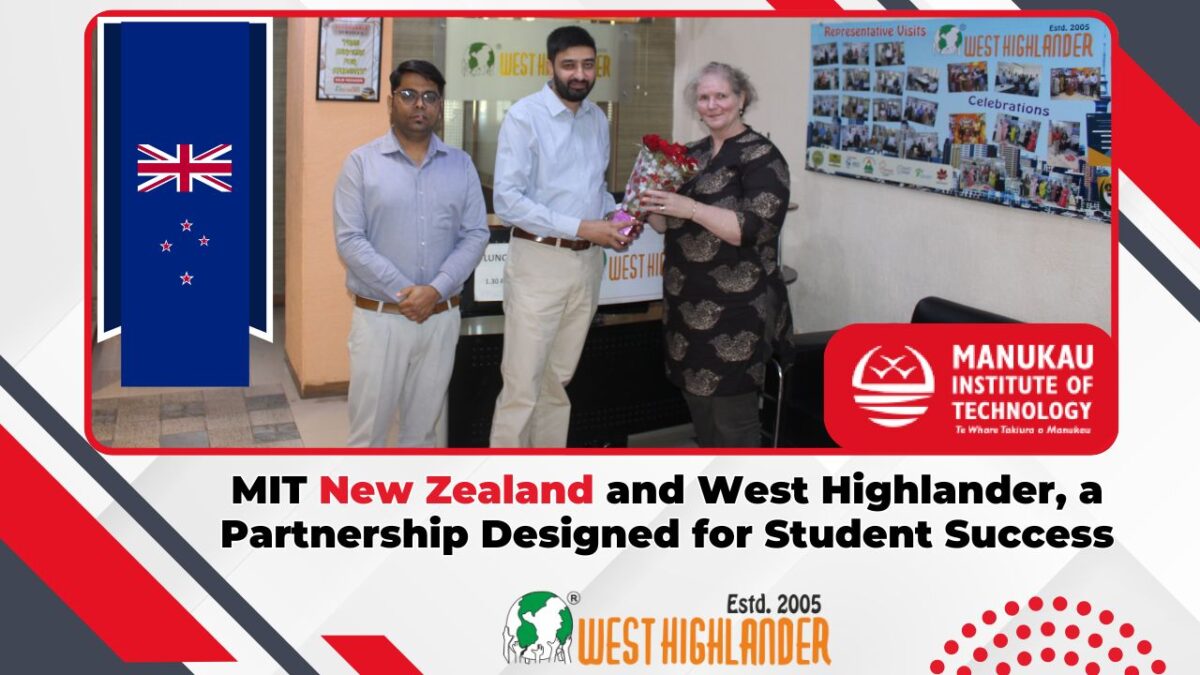
The partnership between Manukau Institute of Technology (MIT), New Zealand, and West Highlander Immigration is not just a name on paper or a logo on a website. It is a working relationship built around one simple goal: making the journey to study in New Zealand clear, honest, and genuinely supportive for Indian students. MIT is a government-owned institute of technology known for practical, career-focused education, and West Highlander has been working as an official MIT NZ agent in India because of its strong student-first approach and deep understanding of New Zealand education and immigration systems. With the support of the official MIT NZ representative in India, Kerry Clarke, this partnership creates a direct and reliable connection between Indian students and the institute. It ensures that students are not navigating the process alone or depending on half-true information from the internet. Instead, they receive guidance that reflects how MIT actually operates, both academically and administratively.
- Official and Authorised MIT Representation in India: As a recognised MIT NZ agent in India, West Highlander provides students with authentic, up-to-date information directly shared by Manukau Institute of Technology. This includes accurate details about programmes, tuition fee ranges, intakes, academic requirements, and English language criteria. Students do not have to worry about outdated blogs or confusing forums. Everything shared is verified and aligned with MIT’s current policies, helping students plan their study journey with confidence from the very beginning.
- Personalised Counselling That Starts With You: No two students are the same, and this partnership respects that. As an experienced MIT NZ counsellor in India, West Highlander focuses on understanding each student’s background, strengths, gaps, and long-term goals before suggesting a pathway. Whether a student is aiming for a certificate, diploma, bachelor’s degree, or higher-level qualification, counselling is tailored, realistic, and practical. The involvement of the MIT NZ representative in India ensures that advice is not generic, but closely matched to what MIT expects from incoming students.
- Clear and Practical Understanding of Entry Requirements: MIT offers a wide range of programmes across health, engineering, digital technologies, business, trades, and creative fields, each with specific entry criteria. Through this partnership, students receive step-by-step guidance on academic requirements, English language scores, and any additional conditions related to their chosen programme. This clarity reduces mistakes, avoids unnecessary delays, and helps students submit strong and complete applications the first time.
- Scholarship Awareness and Financial Planning Support: Studying in New Zealand is a big investment, and financial clarity matters. West Highlander supports students by explaining tuition fee ranges at MIT, identifying available scholarships, and guiding students on how and when to apply. Rather than making unrealistic promises, the focus is on transparent financial planning so families can make informed decisions. This balanced approach helps students manage costs while exploring genuine opportunities offered by MIT.
- Smooth Application and Offer Letter Process: The partnership ensures close coordination with MIT’s admissions team, making the application process efficient and organised. From document preparation and application submission to offer letter follow-ups, every step is carefully managed. This reduces stress for students and ensures timelines are respected. Students can feel confident knowing their application is handled accurately by an official MIT NZ agent in India.
- Structured and Honest Student Visa Guidance: New Zealand student visa preparation can feel overwhelming, especially for first-time applicants. Through this partnership, students receive clear guidance on visa documentation, timelines, and how to present their study plan correctly. The process is explained in simple terms, helping students understand what immigration authorities expect and how to prepare confidently without panic or confusion.
- Direct Access to MIT Through Official Channels: One of the strongest advantages of this partnership is direct communication with MIT via the MIT NZ representative in India, Kerry Clarke. Student queries related to programmes, admissions, or processes are addressed through official channels, ensuring consistency and accuracy. This direct link removes guesswork and creates a transparent flow of information between the student, West Highlander, and MIT.
- Real Insight Into Campus Life and Student Support at MIT: MIT is known for its inclusive campus culture, strong student services, and practical learning environment. Through this partnership, students are guided on what to expect beyond academics, including orientation programmes, academic support, wellbeing services, and everyday student life in Auckland. West Highlander prepares students before departure so they arrive informed, confident, and ready to settle in.
- Support That Continues Beyond Admission: The partnership does not end once the offer letter is issued. Students receive assistance with pre-departure planning, travel preparation, and transition guidance, while MIT provides academic and pastoral support after arrival. This continuity ensures students feel supported at every stage, from planning in India to studying on campus in New Zealand.
- Strong Focus on Career and Industry Readiness: MIT’s teaching model is built around applied learning and industry relevance, and this is reinforced through West Highlander’s guidance. Students are helped to understand how their chosen programmes connect with real-world skills and career opportunities in New Zealand. This career-focused perspective allows students to choose courses with clarity and purpose, not just popularity.
- A Transparent, Student-Centric Partnership: At its core, the partnership between Manukau Institute of Technology and West Highlander Immigration is about trust, transparency, and long-term student success. It creates a dependable bridge between India and New Zealand, combining academic authenticity with genuine immigration support. For students planning to study in MIT, this partnership turns a complex process into a structured, supportive, and achievable journey.
Ready to take the next step?
At West Highlander, we don’t believe in rushing students or selling dreams that don’t match reality. We walk with you, step by step, from choosing the right MIT programme to preparing documents, planning finances, and confidently applying for your New Zealand student visa. Whether it’s understanding entry requirements, aligning intakes, managing costs, or simply calming those last-minute nerves, we’re here for all of it. Think of us as that one friend who’s already done the homework and actually wants you to win. Studying at Manukau Institute of Technology is a big move, and big moves deserve clear guidance, honest answers, and real support. When you’re ready to turn “maybe someday” into “this is happening,” we’re ready to help you take off, smoothly, confidently, and with zero guesswork. Your MIT journey doesn’t start at the airport. It starts with the right guidance.