
Picture this not as a blog, but as the opening sequence of a powerful story.
The screen fades in slowly. A student sits awake late at night, scrolling, thinking, questioning. The world feels noisy, choices feel heavy, and the future feels important. Then the noise fades. A calm country appears on the screen. Green land. Clear skies. A place where education is respected and life moves with purpose. That place is New Zealand. And the thought to study in New Zealand is no longer just a dream. It becomes a calling. Every meaningful journey needs two things. The right destination, and the right guidance. This is where the Southern Institute of Technology, New Zealand enters the story. SIT is not built on hype. It is built on outcomes. Known for practical education, industry-aligned programmes, and genuine support for international students, SIT focuses on preparing students for real careers and real lives. It is an institute that understands ambition, but never rushes it.
Now, the story connects. Because choosing the right institute is only half the journey. The other half is choosing guidance you can trust. This blog is written under the direction of Ms. Parwinder Kaur, a Licensed Immigration Adviser, whose experience brings clarity, accuracy, and honesty to every detail shared here. Her guidance ensures that this is not just inspiring to read, but correct, reliable, and aligned with a genuine New Zealand student visa pathway. Alongside this, we share our close partnership with SIT and the role of West Highlander as a trusted SIT NZ agent in India. From course selection to visa filing, every step is connected, planned, and supported. This blog is where all these paths meet. The dream. The institute. The guidance. And you. Stay with us. The story is just beginning.
About Southern Institute of Technology, New Zealand
And where our story pauses for a breathtaking wide shot, the scene now zooms into the next major character in our film-like narrative: the Southern Institute of Technology, New Zealand, with all its depth, legacy, values, and heartbeat that shapes the journey of every student who steps onto its campuses. From this point forward, imagine every paragraph as another scene unfolding naturally, building the connection between what you just read and the real world of opportunity that SIT offers. Southern Institute of Technology (commonly known as SIT) began its journey in 1971 in Invercargill, on the South Island of New Zealand, with a mission that still shines today: to provide quality applied vocational education that equips people with knowledge and skills needed for the workplace. This mission is not just a line on a page, it is a living promise that guides every classroom, workshop, and student support service at SIT. From its main base in Invercargill, where SIT first opened its doors to campuses in Queenstown, Gore, and Balclutha (Telford), the institute has grown as a community of learners without losing its warm, personal feel. The atmosphere at SIT is more than educational: it feels like a collaborative place where students from around the world learn alongside Kiwi peers, sharing both knowledge and life experiences. SIT’s campuses are designed not just for lectures, but for doing, exploring, and experiencing. Invercargill’s main campus hosts a vibrant mix of facilities, including modern libraries, practical labs, creative spaces, and community areas. There’s even a dedicated creative centre and studios for art, film, music, and media, places where theory meets hands-on creativity and innovation.
What makes SIT truly different and a compelling chapter in this unfolding story is its blend of theory and real-world practice. Here, learning does not happen only through textbooks. Students are encouraged to apply what they learn, to work with real tools, real problems, and real industry scenarios. From practical labs to community projects, every step prepares you for life beyond graduation. At the heart of SIT’s educational philosophy is industry exposure. The institute works closely with employers and local businesses, so students find not just knowledge, but connections to real careers. These partnerships help ensure that what you learn is what the industry needs, a powerful advantage whether you plan to work in New Zealand or return home with global experience. SIT also understands that learning is more than academics. It is about feeling welcomed, supported, and confident in a new culture. That’s why international student support is woven into the fabric of campus life. From orientation and academic advising to career workshops and wellbeing services, SIT supports students academically, personally, and professionally, helping them settle into life far from home with ease and comfort. The institute’s teaching staff are a blend of experienced professionals and dedicated educators, focused on creating learning environments where questions are encouraged and curiosity is celebrated. With smaller class sizes, students receive personalised attention that makes learning feel engaging and supportive. Life on and around SIT campuses also reflects the balance New Zealand is known for, a calm, welcoming environment where safety and serenity allow students to focus on growth without distraction. A quieter pace of life does not mean a lesser experience. Instead, it opens up room for focus, exploration, and deeper personal and academic development in a community that values balance.
In this chapter of your story, Southern Institute of Technology is more than an institute. It is a place where ambition finds direction, where practical skills meet opportunity, and where real futures begin. And as we continue this narrative together, you’ll see why SIT is not just a name on a list: it’s a launching pad for the next scene in your life’s story.
Top Programs offered at Southern Institute of Technology (SIT), New Zealand
As our story moves forward, the camera slowly shifts again. The setting is familiar now. You are no longer just watching from the outside. You are part of the journey. You have seen the place. You have felt the environment. You understand the values. Now comes the moment every great film builds toward: choice. The moment where direction becomes clear. For students planning to study in New Zealand, this is the scene where dreams begin to take a practical shape. Because once the destination is chosen and the guidance is trusted, the next question naturally rises. What will I study? Which path will truly take me forward? This is where study in SIT 2026 becomes more than a plan. It becomes a personalised journey. Southern Institute of Technology is known not just for education, but for offering programmes that speak directly to real careers, real skills, and real futures. The institute carefully designs its programmes to match industry needs, global standards, and student ambitions. For international students, this balance matters deeply. It is not only about earning a qualification, but about gaining confidence, experience, and direction in a new country.
In this part of the story, we turn our focus to the top programmes offered at SIT that international students consistently choose. These programmes stand out because they combine strong academic foundations with hands-on learning, industry exposure, and supportive teaching. They are designed for students who want clarity, growth, and long-term value from their education in New Zealand.
HOSPITALITY
Hospitality is one of the strongest and most recognised study areas at the Southern Institute of Technology, New Zealand. Over the years, SIT has earned a solid reputation for hospitality education because of its practical teaching style, industry-focused training, and clear connection to real jobs. Many international students who plan to study in New Zealand choose SIT specifically for hospitality, as the institute understands this industry deeply and teaches it in a very hands-on and realistic way. Hospitality as a field is wide and people-focused. It includes hotels, resorts, restaurants, tourism businesses, travel services, event operations, and customer service management. At SIT, hospitality is not treated as just classroom learning. Students are trained to understand how hospitality businesses operate daily, how service standards are maintained, how teams are managed, and how customer experience is created from start to finish. The learning approach focuses on real situations that students will face in the workplace. Southern Institute of Technology offers several well-structured hospitality programmes for international students. These include the Diploma in Hospitality Management, which builds a strong base in hospitality operations, food and beverage service, front office skills, and supervision. It is ideal for students who want to enter the industry with practical skills. The Graduate Diploma in Hotel Management is designed for students who already hold a qualification and want to shift into hotel or hospitality management roles. This programme focuses more on leadership, operations control, and management-level understanding.
SIT also offers the Diploma in Tourism and Travel, which focuses on tourism operations, travel services, customer handling, and destination knowledge. This programme suits students interested in tourism offices, travel agencies, tour operations, and visitor services. For those aiming for higher-level roles, the Bachelor of Hotel Management provides deeper knowledge of hospitality operations combined with business, leadership, and strategic management skills. One reason SIT is so well known for hospitality is its strong practical focus. Students are trained in realistic learning environments and guided by tutors who have real industry experience. This helps students gain confidence, improve communication skills, and understand workplace expectations. The teaching style is supportive, clear, and very student-friendly, which is especially helpful for international students adjusting to a new country. Hospitality programmes at SIT are best suited for students who enjoy working with people, have good communication skills, and like dynamic, fast-moving work environments. These programmes are ideal for students who see themselves working in hotels, resorts, restaurants, tourism companies, airlines, cruise services, or customer service management roles. Career outcomes after hospitality study can include roles such as hotel supervisor, front office executive, food and beverage manager, guest services coordinator, tourism officer, travel consultant, event coordinator, or hotel manager over time. For students planning to study in SIT 2026, hospitality offers a practical, globally relevant career path with skills that are valued across countries and industries.
INFORMATION TECHNOLOGY
Information Technology is also one of the most in-demand and future-oriented fields globally, and the Southern Institute of Technology (SIT), New Zealand, has built a strong reputation for delivering practical, industry-relevant IT education. Known for its applied learning approach, SIT focuses on preparing students with real-world technical skills that match current industry needs, making it a preferred choice for international students planning to study IT in New Zealand. SIT’s Information Technology programmes are designed to combine strong theoretical foundations with hands-on practical learning. Students do not just learn concepts; they learn how to apply technology in real business and organisational environments. The curriculum emphasises problem-solving, system development, data management, networking, and modern computing practices, which helps students develop confidence and job-ready skills. The institute offers a well-structured range of IT programmes at different academic levels, suitable for students from diverse educational backgrounds. The Bachelor of Information Technology is ideal for students who want to build a solid foundation in computing and IT systems. This programme covers areas such as programming, databases, networking, web development, information systems, and software development, with a strong focus on practical projects and applied assessments.
For students who already hold a qualification in another field and wish to transition into IT, SIT offers the Graduate Diploma in Information Technology. This programme helps students gain essential technical skills in a shorter timeframe and is particularly suitable for career changers. Students learn core IT concepts, programming fundamentals, and systems knowledge required for entry-level roles in the IT sector. The Postgraduate Diploma in Information Technology is designed for students who want advanced technical knowledge and deeper understanding of IT systems. It focuses on higher-level problem-solving, system analysis, and applied computing skills, preparing graduates for specialised or senior technical roles. Students who wish to further enhance their expertise can progress to the Master of Information Technology, which involves advanced coursework and project-based learning aligned with industry expectations.
One of the key strengths of studying Information Technology at SIT is its applied teaching style. Learning is practical, structured, and supported by experienced tutors who bring industry knowledge into the classroom. Students work on real-life projects, case studies, and system-based tasks that reflect workplace challenges. This approach helps students understand how IT functions in real organisations rather than just in textbooks. SIT’s Information Technology programmes are well suited for students who enjoy working with computers, analysing systems, solving technical problems, and adapting to new technologies. These programmes are especially beneficial for students seeking practical skills that can be applied across multiple industries such as business, healthcare, education, manufacturing, and technology services. Career opportunities after completing an IT qualification from SIT include roles such as software developer, IT support specialist, systems analyst, network technician, web developer, database administrator (junior level), and IT consultant. With technology continuing to grow across all sectors, graduates with applied IT skills from SIT have strong employment prospects both in New Zealand and internationally. For students planning to study in New Zealand, SIT’s Information Technology programmes offer a balanced combination of practical training, academic quality, and career-focused outcomes, making it a strong choice for those looking to build a stable and future-ready career in the IT field.
NURSING
Nursing is one of the fastest-growing and most respected fields at the Southern Institute of Technology, and in recent years it has seen increasing interest from international students planning to study in New Zealand because of strong career demand and real global opportunities. At SIT, nursing education is built on a solid mix of theory, clinical practice, and professional development, giving students the skills and confidence needed for real healthcare environments. Nursing as a profession focuses on caring for individuals, families, and communities across health settings such as hospitals, clinics, aged-care facilities, rehabilitation centres, and community health services. Nurses play a central role in health promotion, illness prevention, patient assessment, clinical care, and advocacy, and New Zealand values highly trained nurses who can support diverse populations with compassion and competence.
Southern Institute of Technology offers several well-recognised nursing pathways for international students: New Zealand Diploma in Enrolled Nursing: This is an 18-month diploma that prepares students to work as Enrolled Nurses, providing hands-on nursing care under the guidance of Registered Nurses. The programme includes classroom theory, clinical simulation, and real clinical placements so students learn practical skills such as patient assessment, nursing practice, acute care, mental health support, and rehabilitation work. On successful completion, graduates are eligible to apply to the Nursing Council of New Zealand to sit the State Exam and become registered as Enrolled Nurses. Bachelor of Nursing, A three-year degree that combines strong theoretical foundations with broad clinical experience. Students learn about health assessment, nursing practice across life stages, primary and acute care, cultural safety, and professional practice. This degree prepares graduates for registration as Registered Nurses (RNs) and equips them to work confidently in hospitals, community health services, and specialised care settings. Master of Nursing Science, For qualified nurses seeking advanced practice skills, leadership roles, clinical decision-making expertise, and research capability, the Master of Nursing Science offers postgraduate study focused on evidence-based practice and advanced nursing knowledge. Graduates become well-prepared for higher-level roles in complex healthcare environments.
SIT’s nursing programmes are delivered by experienced health professionals who bring real workplace insight into the classroom and clinical training. Students also benefit from modern simulation facilities and clinical placements in local hospitals and community health settings, helping bridge classroom learning with real patient care. These nursing programmes are best suited for caring, patient-focused students who enjoy working closely with people, have strong communication skills, and want a meaningful, stable career with global relevance. Nurses trained in New Zealand are in high demand internationally, with opportunities to work in diverse settings such as hospital wards, primary healthcare teams, mental health services, aged care, community support, and specialised clinical teams. Overall, nursing at SIT offers a balanced path to enter a rewarding healthcare profession, develop strong clinical skills, and build a career that makes a real difference to individuals and communities around the world.
BUSINESS, COMMERCE & MANAGEMENT
Business and management studies remain one of the most popular and practical fields at the Southern Institute of Technology, especially for international students who plan to study in New Zealand with a focus on real-world careers. The programmes offered in this field are designed to balance strong academic foundations with practical business understanding, preparing students for dynamic roles in today’s global workplace. SIT’s business courses help learners build skills in leadership, management, finance, marketing, accounting, communication, and project planning, all of which are highly valued by employers worldwide. At SIT, business and commerce education begins with undergraduate degrees such as the Bachelor of Commerce and Bachelor of Accounting. The Bachelor of Commerce provides a broad, solid grounding in commercial knowledge, and students can choose between majors like Management or Marketing, depending on their interests and career goals. This degree combines academic learning with real workplace skills, including analysis, decision-making, and practical business projects, helping graduates step confidently into roles in business operations, leadership, and client-focused sectors. The Bachelor of Accounting is tailored for students who want to specialise in accounting and financial roles. It gives learners a strong understanding of financial reporting, management accounting, auditing basics, and business law, all essential for careers in accounting, finance teams, and business advisory services.
For students who want to build professional management skills beyond a basic degree, SIT offers the Graduate Diploma in Applied Management, which provides learners with deeper practical and theoretical knowledge in areas such as operations, strategy, applied business communication, and problem-solving skills. This programme is ideal for those with existing academic background or work experience who wish to enhance their management capabilities. Taking this one step further, the Master of Applied Management is a postgraduate qualification aimed at those seeking advanced expertise in leadership, strategy, research, and critical thinking. Graduates of this Master’s programme are prepared for senior roles in management across diverse industries, from operations and marketing management to business consultancy and organisational leadership. SIT also offers related business qualifications, such as diplomas and certificates at earlier levels, which help students build foundational administrative and business skills before moving into higher-level study. These pathways make it easier for learners who are either new to business education or who want to transition smoothly into degree programmes.
Business, commerce, and management programmes at SIT are best suited for students who enjoy strategic thinking, leadership roles, working with data, and solving organisational challenges. These studies open doors to careers in business management, marketing, human resources, finance, accounting, project management, and entrepreneurial ventures. With a strong mix of practical and academic learning, students develop both confidence and capability to thrive in New Zealand’s business environment and beyond. In summary, whether a student wants to be a future business leader, a skilled marketer, an accounting professional, or a management specialist, SIT provides clear, career-focused pathways with a blend of real skills and academic knowledge that work well in today’s global economy.
Entry Requirements at SIT for International Students 2026
Now that we have explored the top programmes at SIT and seen how they prepare students for real careers, the next important part of the journey is understanding how to get in. Every student’s dream to study in New Zealand begins with meeting the right entry requirements. These requirements are designed to ensure that students are ready for the level of study they choose, while also making the transition to a new country smooth and successful. For international students, it is not just about grades or certificates, it’s about showing potential, motivation, and readiness to learn in a supportive and practical environment. Understanding these requirements clearly makes the application process simpler and builds confidence as you take the next step toward your future at SIT.
Diploma Level Entry Requirements (NZQA Level 5–6)
To be eligible for a diploma programme at SIT, international students generally need to have completed education equivalent to New Zealand Year 12. This means your high school certificate or senior secondary qualification should meet the entry standards set by SIT’s admissions team; SIT reviews these on a case‑by‑case basis using an international equivalence table. Because English is the language of instruction, students whose schooling was not in English must provide proof of English ability, typically through valid scores in recognised tests like IELTS, TOEFL, PTE or equivalent. If you don’t meet the direct academic or English requirements, SIT may offer foundation or English pathway programmes that help you reach the right level before starting your diploma.
Bachelor’s Degree Entry Requirements (NZQA Level 7)
For a bachelor’s degree such as in commerce, IT, or other fields, you must have completed qualifications equivalent to New Zealand Year 13, which is usually the final year of secondary school. SIT also considers equivalent international high school credentials from recognised systems such as A‑levels, IB, or similar. In some cases, applicants with relevant work experience or completion of recognised qualifications may be considered through a Recognition of Prior Learning (RPL) process. International applicants must demonstrate English language ability. If you did not study in English, you should provide valid IELTS, TOEFL, PTE, NZCEL, or equivalent test results. SIT checks both academic readiness and English skills to make sure you’re prepared for degree‑level study.
Graduate Diploma Entry Requirements (NZQA Level 7)
The graduate diploma is aimed at students who have already completed a bachelor’s degree or equivalent. At SIT, you typically need a relevant undergraduate qualification; applicants sometimes qualify if they have strong professional experience that can be considered in place of formal academic credentials. English language ability is essential for graduate diploma programmes: most require proof such as IELTS Academic around 6.0 with no low band scores, or equivalent proficiency demonstrated through other recognised tests. Because graduate diplomas are professional and specialised, you should be ready to engage with more in‑depth content and independent learning. SIT may request your CV and other evidence of your academic or career background to ensure you are a good fit for the programme.
Postgraduate Diploma Entry Requirements (NZQA Level 8)
To enter a postgraduate diploma at SIT, you need to hold a relevant bachelor’s degree or graduate diploma, usually with at least a solid academic record (often a B grade average). Postgraduate diplomas are more advanced than undergraduate or graduate diplomas, and many programmes prepare students for senior roles or progression into a master’s degree. Because of this, English proficiency requirements at this level are higher: for example, IELTS Academic scores around 6.5 with no band lower than 6.0 are commonly requested, or equivalent TOEFL, PTE, NZCEL or other recognised qualifications. Sit also considers evidence of English‑medium education, such as completion of earlier qualifications in English.
Master’s Degree Entry Requirements (NZQA Level 9)
For a master’s degree, applicants must already have a recognised bachelor’s degree (usually in a relevant field) with acceptable academic standing, and many programmes may also look for related professional experience. Master’s study is more research or professionally focused, and SIT expects students to be prepared for a higher level of independent study, analytical thinking, and advanced coursework. English language requirements are typically more demanding at this level. Although not always listed explicitly on the SIT site, postgraduate and master’s programmes normally expect higher English scores (such as IELTS 6.5 overall with no low band scores), similar to other Level 8 qualifications, and evidence of English‑medium study may also be accepted.
Tuition Fees and Cost of Living at SIT, New Zealand
Now that you understand SIT’s programmes and entry requirements, it’s time to talk about what it actually costs to study in New Zealand at the Southern Institute of Technology in 2026. This part is important because money, tuition fees and everyday living costs, is something all international students need to plan well before starting their journey. SIT is known not only for its practical education and strong student support but also for offering relatively affordable international tuition fees compared with many other global options, which makes studying here realistic and rewarding for many families.
For international students, tuition fees at SIT vary by the level of qualification and the field of study. According to SIT’s official fee schedule for 2026, a Master’s degree such as a Master of Applied Management, Master of Applied Health Sciences or Master of Information Technology is typically priced at about NZD 35,000 for the full 18‑month programme with an additional resource fee of around NZD 2,200, so the total cost comes to roughly NZD 37,200 before any scholarship support. Similarly, a Postgraduate Diploma at Level 8 usually has tuition of about NZD 25,000 per year with a resource fee of about NZD 1,800, making annual costs around NZD 26,800. At the Graduate Diploma level (Level 7), tuition tends to be around NZD 22,500 per year, plus a resource fee of roughly NZD 1,800, adding up to around NZD 24,300 if you are paying the full fee. For Bachelor’s degrees, many courses such as Bachelor of Commerce, Bachelor of Information Technology, or Bachelor of Hotel Management are often priced at about NZD 22,500 per year with similar resource fees, resulting in total annual costs near NZD 24,300. Some specialised bachelor programmes like Bachelor of Engineering Technology or Bachelor of Nursing may have slightly higher fees (around NZD 25,300 to NZD 30,000 per year) with the same resource contribution.
For shorter vocational qualifications such as the New Zealand Diploma in Enrolled Nursing (Level 5), the total tuition for the full 18‑month qualification is approximately NZD 31,550, plus a resource fee of about NZD 2,700, which brings the overall cost close to NZD 34,250. It’s important to note that SIT also offers scholarships and fee reductions for international students. Many qualifications have scholarship options that can reduce the total cost by several thousand dollars, and students must include a personal statement when applying to be considered for these. Additionally, some external awards and regional grants are available to support students, further easing the financial load. Alongside tuition, students must plan for the cost of living in New Zealand. Immigration New Zealand guidelines suggest that international students should budget a minimum of around NZD 15,000 per year to cover basic living expenses such as food, transport, utilities, and personal items, but many students spend more comfortably close to NZD 20,000 per year. Many students in Invercargill, where SIT’s main campus is located, find the cost of living slightly lower than in larger cities like Auckland or Wellington, which can make daily life and housing more affordable while studying. Your living expenses include rent or accommodation costs (shared flats or homestays), groceries, phone and internet, transport, and entertainment. Keep in mind that health and travel insurance is usually included as part of SIT’s resource fee for mainstream students, so you don’t have to arrange this separately, one less thing to worry about when you arrive.
In summary, the tuition fees at SIT for international students in 2026 range from around NZD 24,000 per year for many undergraduate and graduate diplomas up to around NZD 37,000 for master’s programmes before scholarships. Combined with the cost of living in New Zealand, often around NZD 15,000–20,000 annually, students can plan their budgets realistically before making the life‑changing decision to study in New Zealand. With careful planning and the availability of scholarships, SIT remains one of the more affordable, high‑quality options for international study.
Scholarships for International Students at sit 2026
One of the most encouraging parts of planning to study in New Zealand at SIT is knowing that there are many scholarship options to help make your dream more affordable. These scholarships are designed to support international students who want to study at SIT, whether they are planning undergraduate or postgraduate study. Scholarships not only reduce the cost of tuition fees but can also ease the financial burden of studying abroad, making the journey smoother and more rewarding. The Southern Institute of Technology offers a range of scholarships, grants and study grants for international students across different levels and fields of study. These awards are made possible through SIT’s close connections with local business groups, community organisations, and partnerships with educational programmes, each aimed at helping worthy students reduce costs and focus on learning. To be considered, most scholarships require that you accept an offer to study at SIT first and usually submit a short written statement explaining why you’re a good candidate.
One of the main scholarship schemes at SIT is the Southland Chamber of Commerce Scholarships. These are offered in both undergraduate and postgraduate categories and typically cover a set amount like NZD 3,500. The postgraduate scholarship is available to students enrolled in Master’s or Postgraduate Diploma programmes in areas such as Applied Management, Information Technology, and Health Sciences. The undergraduate scholarship supports students in degrees like Bachelor of Commerce, Bachelor of Information Technology, Bachelor of Sport and Exercise, and others. For nursing students, there’s the Great South Nursing Degree Scholarship, often worth around NZD 4,000. This award is specifically for those studying nursing, helping to reduce the tuition burden for students entering one of New Zealand’s most in-demand professions.
Hospitality and business students can also benefit from specialised awards such as the ILT Academy Hotel Management Scholarship, also typically around NZD 3,500, for students enrolled in hotel and hospitality programmes. Additionally, there are industry-aligned study grants like the Great South Agriculture Foundation Scholarship, the Engage South Engineering Scholarship, and others supporting disciplines such as agriculture and engineering. SIT also offers study grants based on student origin regions, which provide fixed amounts (around NZD 3,000) to students from specific areas such as South East Asia, Latin America, the Pacific Islands, or Southland regions. These grants are designed to help cover part of your tuition or study costs and are available for a wide range of programmes.
One special option students can explore is the SIT Zero Fees English Study Grant, which lets international students studying English certificates (NZ Certificate in English Language) get their English tuition fee credited towards their main degree or diploma at SIT once they progress to the next level of study. This can effectively reduce the cost of your main course by the amount you paid for English. Outside of these SIT-specific awards, SIT is also an approved host for New Zealand Government scholarships through the Ministry of Foreign Affairs and Trade (MFAT). These are larger government-funded scholarships available to eligible students from selected developing countries. MFAT scholarships can include full tuition coverage, living allowances, travel, insurance, and other support, especially for students whose study will help their home country on return.
It’s important to know that scholarship places are limited and not every applicant will receive one, eligibility depends on your programme, qualifications, supporting statement, and sometimes interviews or additional documentation. But applying for them is a powerful way to reduce the cost of your study, relieve financial pressure, and make your time at SIT and in New Zealand even more rewarding.
Intakes at SIT, New Zealand for International Students 2026
When students think about studying at the Southern Institute of Technology, one of the quiet advantages that slowly turns into a big relief is SIT’s flexible intake system. Life does not always move in straight academic lines. Results get delayed, English tests take time, finances need planning, and sometimes courage itself needs a little space to grow. SIT understands this rhythm. That is why its intakes feel less like rigid gates and more like open doors, welcoming students when they are truly ready to walk in. For most international students, especially those planning to study in New Zealand in 2026, the main intakes at SIT fall in February and July. These intakes sit perfectly within New Zealand’s academic calendar and are ideal for diploma, bachelor’s, graduate diploma, postgraduate diploma, and master’s programmes. The February intake often feels like a fresh sunrise, a clean start to the academic year, while the July intake arrives like a second chance, giving students who needed more time the confidence to step forward without feeling rushed or left behind.
What makes SIT even more appealing is that, for selected programmes, it goes beyond fixed dates. Some courses offer flexible or rolling intakes, especially at diploma and postgraduate levels. This means SIT adapts to students, not the other way around. If you miss one intake due to documentation, English requirements, or personal reasons, the dream does not collapse. It simply waits for the next opening. This flexibility is one of the reasons SIT attracts students from diverse backgrounds, different age groups, and varied academic journeys. From a practical point of view, SIT’s intake structure also aligns smoothly with the New Zealand student visa process. Students are advised to apply at least six to eight months in advance, giving enough breathing room for offer letters, fee arrangements, medicals, and visa approvals. Popular programmes, particularly in high-demand areas, can fill up quickly, so early planning turns hope into certainty. In the larger story of studying at SIT, intakes are not just dates on a calendar. They are carefully placed stepping stones, guiding students forward without pressure. They reflect SIT’s belief that education should fit into your life, not force you to rearrange it completely. And that is exactly where SIT begins to feel less like an institution and more like a partner in your New Zealand journey.
Our Partnership with SIT and its Benefits
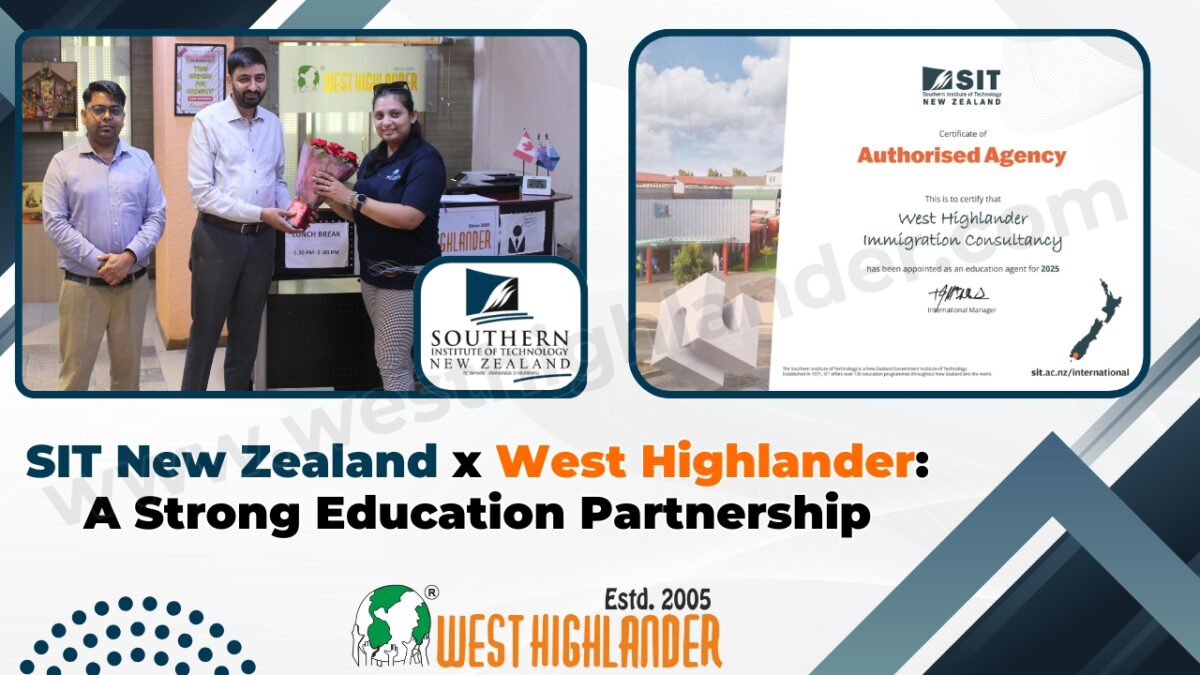
- Our partnership with Southern Institute of Technology, New Zealand (SIT) is not just a professional tie-up on paper. It is a student-first collaboration built with one clear purpose: to make the journey to study in New Zealand simple, transparent, and genuinely achievable for Indian students. SIT is known globally for its practical education, strong industry focus, and student-friendly learning environment. By working closely with SIT, West Highlander Immigration ensures that students receive authentic information, correct guidance, and end-to-end support at every stage of their journey.
- This partnership is strengthened through direct coordination with Ms Sayani Bhowmick, the SIT NZ representative in India, who plays a key role in connecting students, counsellors, and the institute. Her involvement ensures that the guidance students receive is not second-hand or assumed, but accurate, current, and aligned with SIT’s real expectations.
- As a recognised SIT NZ agent in India, West Highlander Immigration acts as a trusted bridge between students in India and SIT in New Zealand. This means students no longer have to depend on online guesses, incomplete information, or confusing forums. Every detail related to programmes, intakes, fees, entry requirements, and campus options comes directly from SIT, helping students plan with confidence and clarity from day one.
- One of the biggest benefits of this partnership is personalised counselling. No two students have the same background, goals, or concerns. As an experienced SIT NZ counsellor in India, West Highlander carefully understands each student’s academic history, work experience, and future plans before suggesting a programme. Whether a student is planning a diploma, bachelor’s degree, postgraduate programme, or applied master’s course, the advice is practical, honest, and realistic. The goal is not just admission, but long-term success.
- Understanding entry requirements can often feel overwhelming, especially when different programmes have different academic and English language criteria. Through our partnership with SIT, students receive clear explanations of what is required, what is flexible, and what needs improvement. This reduces application errors, avoids unnecessary rejections, and ensures that students apply only when they are genuinely ready.
- Financial planning is another area where this partnership adds real value. Studying abroad is a major investment, and students deserve clarity. West Highlander guides students on tuition fees, living costs, and any applicable scholarships offered by SIT. By combining financial guidance with academic planning, students and families can make informed decisions without last-minute stress.
- The application and offer letter process also becomes smoother through this collaboration. From document preparation to submission and follow-ups, West Highlander works closely with SIT’s admissions team. This reduces delays, avoids mistakes, and keeps students informed at every step. Students feel supported rather than lost in the process.
- When it comes to the New Zealand student visa, correct planning is critical. While SIT focuses on education, West Highlander supports students with visa preparation, ensuring that their study plans align with immigration expectations. This integrated approach helps students present themselves as genuine applicants with clear intentions to study in New Zealand.
- A major strength of this partnership is direct communication. With Ms Sayani Bhowmick, SIT NZ representative in India, involved, student queries are resolved quickly and accurately. This direct link builds trust and removes confusion, especially for students making such an important life decision.
- Beyond admission, the partnership also prepares students for real life in New Zealand. From understanding campus facilities and student support services to settling into a new culture, students receive guidance that goes beyond academics. This continuity of care helps students feel confident, supported, and ready for their new journey.
- At its core, this partnership is built on trust, transparency, and student success. By working together, SIT and West Highlander Immigration create a clear and reliable pathway for Indian students who truly want to study in New Zealand. It is not just about reaching New Zealand, but about reaching there prepared, confident, and supported every step of the way.
How we can help you?
As you reach the end of this guide, one thing becomes clear: studying at the Southern Institute of Technology is not just about choosing a college, it is about choosing a future that is practical, focused, and full of real possibilities. If you see yourself building a career through hands-on learning, industry-relevant programmes, and a supportive New Zealand environment, then SIT could be the right place for you. And you do not have to walk this path alone. With West Highlander Immigration, an authorised SIT NZ agent in India, you receive honest guidance, clear answers, and step-by-step support from course selection to visa approval. Under the direction of Ms Parwinder Kaur, Licensed Immigration Adviser, your journey is planned carefully and correctly. If you are ready to turn your dream to study in New Zealand into reality, now is the time. Connect with us, explore your options, and apply to SIT with confidence. Your next chapter is waiting, and we are here to help you begin it the right way.